PHASE 5 · ROAD TEST READINESS

Get Your Teen Road Test Ready

Phase 5 of the Zutobi Parent Driving System. Refine weak skills, practice the maneuvers examiners score, and build calm confidence before test day.

Teens with actively involved parents are 50% less likely to crash in their first year of driving. See the research

78%
ROAD TEST READY
Phase 5 · Final stretch
Not Ready
Practicing
Ready
FOUR SIGNS · UNPROMPTED4 signals
  • Mirror & blind-spot scans
    Automatic, no reminders
  • Distraction management
    Self-regulated
  • Hazard response
    No freezing, no panic
  • Frustration in traffic
    Calm, regulated
25%READINESS SIGNALS

How do I know when my teen is ready for the driving test?

Your teen is ready when four things happen without your prompting: they scan mirrors and blind spots automatically, they manage distractions on their own, they respond to unexpected hazards without freezing, and they regulate frustration in traffic.

If you still remind them to check a mirror or stay calm at a yellow light, they need more practice. The Zutobi Parent Driving System covers this in Phase 5, with coaching points for each readiness marker. See the full system

  1. Scans mirrors and blind spots automatically
    No verbal prompts from you
  2. Manages distractions on their own
    Phone away, eyes forward, by default
  3. Responds to unexpected hazards without freezing
    Acts within a beat, not after
  4. Regulates frustration in traffic
    Stays composed at yellow lights and slow drivers

Your instructor

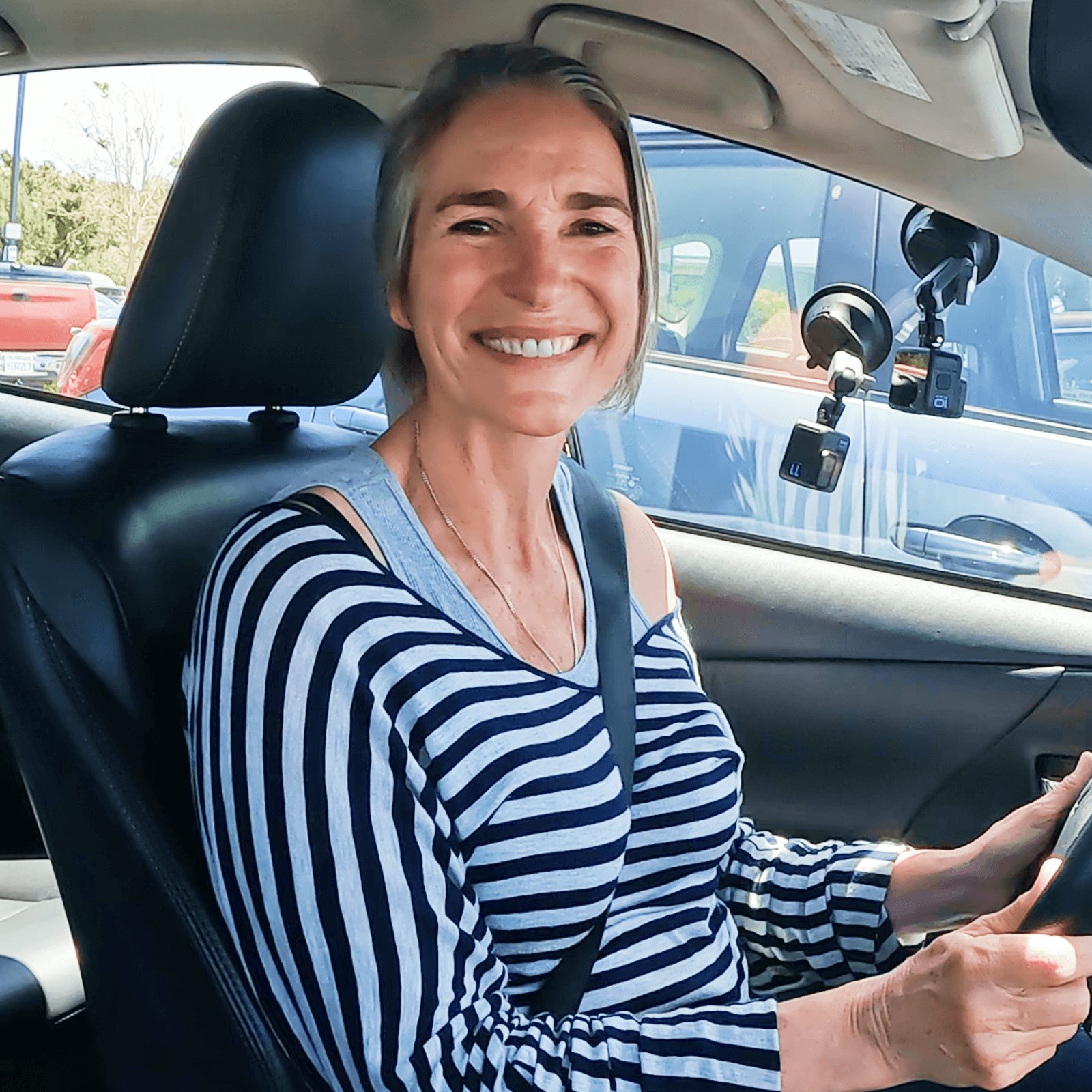
Jacqueline

40%TEST MANEUVERS

Test maneuvers your state examiner will score

Most road tests include a set of low-speed maneuvers. Your teen should perform each one smoothly before scheduling the exam.

01

U-turns and 3-point turns

Practicing

U-turns work on wide roads with clear sightlines. Your teen checks traffic in both directions, signals, and completes the turn without stopping in the oncoming lane.

For narrow streets, a 3-point turn is the alternative: signal, drive forward to one side, reverse in the opposite direction, then move forward in the new direction. Practice both until your teen can judge the road width and pick the right maneuver without your input.

02

Reversing around a corner

Needs work

The PTTG teaches this as 90-degree backing turns. Your teen pulls forward into a parking lane, then reverses out with a 90-degree turn.

If the car drifts too close or too far, use quarter-turn corrections. Small steering inputs produce big changes in reverse.

Stop and ask: "Are we parallel? Did we clear the obstacle?" If not, pull forward and try again.

Certified driving instructor Jacqueline

Trace the curb. Your teen looks over the turning shoulder and uses the curb line as a visual guide to wrap around the corner.

03

Serpentine steering

Mastered

Set up cones 18 feet apart in a straight line. Your teen drives forward through the course, then backs through it to build precision steering and counter-steer timing.

The coaching cue from the PTTG: your teen should begin to counter-steer as the front end crosses the imaginary line between two center cones. The speed of the counter-steer increases as the car moves across the centerline.

55%SKILL STATUS

A test-day skill grid

Score every test-required skill before the exam. Sort visually by where the work still is.

Mastered Practicing Needs work
  • Right and left turns
    Mastered
    Smooth, signaled, lane-correct
  • Lane changes (multi-lane)
    Mastered
    Mirror-signal-shoulder check
  • Stops at signs and signals
    Mastered
    Anticipates, no lurching
  • U-turn / 3-point turn
    Practicing
    Picks the right maneuver most days
  • Parallel parking
    Practicing
    Curb distance still inconsistent
  • Mirror & blind-spot scan
    Mastered
    Automatic, every maneuver
  • 90-degree reversing turn
    Needs work
    Drifts wide; rerun "trace the curb"
  • Serpentine counter-steer
    Mastered
    18-ft cone course, both directions
  • Smooth braking control
    Practicing
    Light vs firm pressure understood
  • Navigation / unfamiliar route
    Practicing
    GPS-set pre-drive, recovers from reroute
  • Frustration regulation
    Mastered
    Stays calm at yellow lights
  • Pre-drive checklist
    Needs work
    Skips mirror adjust under pressure
60%BRAKING CONTROL

Safe stops and braking control

Smooth, controlled stops matter on the road test and on every drive after it. Start on a quiet neighborhood street.

Have your teen practice braking at different speeds and pressures. Show how light pressure produces a gradual stop and firm pressure produces an urgent one.

At stop signs and traffic lights, your teen should anticipate the stop and begin decelerating early. A complete stop behind the stop line, no lurching, is what examiners score.

Stopping distance changes with speed: roughly 120 feet at 30 mph, roughly 360 feet at 60 mph. Rain, worn tires, and distraction extend those numbers further.

Stopping distance · approx
Doubling speed from 30 mph to 60 mph roughly triples stopping distance — from 120 ft to 360 ft.
30 MPH~120 ft
60 MPH~360 ft
Rain, worn tires, distraction: extends both numbers further.
70%NAVIGATION

Navigation and trip planning

Before the road test, your teen should be able to find an unfamiliar address, follow the route, and adjust when something changes.

Practice planning a route together: check traffic, check weather, pick an alternate road. Then let your teen drive it while you call out turns the way an examiner would.

  • Set the GPS destination before the car moves. No phone interaction while driving.

  • If the GPS reroutes mid-drive, your teen listens to the audio instruction and makes the turn safely.

  • Teach your teen to read road signs independently. Route markers, speed limit changes, lane-use signs, and construction warnings all appear on test routes.

80%MOCK TEST

Run a mock driving test

The best prep for the road test is a rehearsal that matches the real conditions.

  1. ROUND 01

    Drive the DMV neighborhood

    Drive to the DMV your teen will use and follow the surrounding streets for 15 to 20 minutes. Cover right turns, left turns, lane changes, stops, and at least one parking maneuver.

  2. ROUND 02

    Examiner-style instructions

    Give instructions the way an examiner would: brief, calm, with enough lead time to react. Score each maneuver as clean, needs work, or not attempted.

  3. ROUND 03

    Three different days

    Run at least three mock tests on different days. Familiarity with the route and format lowers anxiety more than extra hours of random driving.

Score each maneuver
Clean Needs work Not attempted
Familiarity with the route and format lowers anxiety more than extra hours of random driving.
88%PRE-DRIVE ROUTINE

A pre-drive routine that reduces test anxiety

Anxiety on test day comes from unpredictability. A consistent pre-start sequence gives your teen something familiar to anchor to.

  1. 01Check tires
  2. 02Scan the path of travel
  3. 03Clear windows
  4. 04Secure loose items
  5. 05Buckle up
  6. 06Adjust mirrors
  7. 07Hands to 9-and-3
Shutdown sequence — locks in the same way
StopParkPowerBrakeExit
Instructor Jacqueline

The matching shutdown sequence is "Stop-Park-Power-Brake-Exit." The startup version locks in the same way.

On test day, arrive 15 minutes early and run the checklist at normal speed. The routine replaces last-minute coaching.

92%TEST DAY

What to expect on test day

Your teen will check in at the DMV, present their permit, and show proof of insurance and registration. An examiner gets into the passenger seat and gives verbal instructions throughout the drive.

Common test maneuvers:
  • Right and left turns at intersections
  • Lane changes on a multi-lane road
  • Stopping at signs and signals
  • Parallel parking or pull-in parking
  • One reversal maneuver (3-point turn, reverse, or straight-line backing)
  • Scanning mirrors and blind spots during every maneuver

The examiner scores each item. Most states allow a limited number of minor errors but fail on any critical safety mistake: running a stop sign, failing to yield, or an unsafe lane change.

You cannot ride along during the test in most states. Your teen drives alone with the examiner.

95%IF THEY DON'T PASS

If your teen fails the road test

38%
of first-time road test takers do not pass

Roughly 38% of first-time road test takers do not pass. A failed test is data, not a crisis.

Most states hand you a scoring sheet after the test. Use it to build your next practice plan: if parallel parking was marked, run that maneuver ten times before rescheduling.

Wait the required period (check your state's parent guide for timing), then rebook. Many teens pass on the second attempt after targeted practice on the items they missed.

Do not add pressure. Reframe the result: "Now we know exactly what to work on."

See state requirements
100%INSIDE THE SYSTEM

Inside the Zutobi Parent Driving System

Phase 5 of the PTTG covers every maneuver in this guide with video walkthroughs and coaching cues you can use during practice.

  • 90-degree backing turns with the "trace the curb" technique, led on video by instructor Jacqueline.
  • Serpentine course for forward and backward precision steering.
  • Mock test structure so you can simulate the exam at home.
  • Safe stopping drills at varied speeds and conditions.

Your instructor

Jacqueline

Certified Driving Instructor · Zutobi PTTG

CHOP/State Farm research: actively involved parents reduce their teen's crash risk by 50% and intoxicated driving risk by 71%.

Follow the Zutobi Parent Driving System
FAQ

Road Test Readiness FAQ

Every state allows retakes. Most require a waiting period of one to two weeks between attempts. Check your state's parent guide for the exact rules.

Most states test right and left turns, lane changes, stops at signs and signals, one parking maneuver, and one reversal such as a 3-point turn or straight-line backing. The exact list varies by state.

Most states do not allow a parent in the car during the exam. Your teen drives alone with the examiner.

Build a consistent pre-drive routine your teen runs before every practice session. By test day, the routine is automatic, and that predictability lowers anxiety.

Yes. Instructor Jacqueline walks you through 90-degree backing turns, serpentine steering, 3-point turns, and safe stops on video, with coaching points you can repeat during practice.

A Virginia Tech study found that teens with varied, structured practice had 30% fewer high-risk events after licensure. Targeted maneuver practice outperforms aimless road time.

They scan without reminders, manage distractions alone, handle unexpected hazards calmly, and regulate frustration in traffic. If you still prompt any of these, keep practicing.

About 38% of first-time takers do not pass. Review the scoring sheet, target the missed items in practice, wait the required period, and rebook.

START NOW

Follow a Structured System Inside Zutobi

Give your teen the safety advantage that research supports. Start the Zutobi Parent Driving System.