loved by
15.1+ million
users
2026 Motorcycle License & Test Updates: What Riders Need to Know (By State)

Getting a motorcycle license in 2026 looks a little different depending on the state. A handful of states chaged how the test is given, the rules on lane filtering keep shifting, and electric motorcycles are forcing DMVs to rewrite their definitions. Most of the country kept its motorcycle test the same this year, so the smartest move for new riders is to know exactly what changed in their state.
2026 Motorcycle Updates at a Glance
| State | 2026 update | What it means for riders |
| Florida | All license exams, including motorcycle, are English only as of February 6, 2026 | Knowledge test and skills evaluation must be completed in English; no interpreters during testing |
| California | Off-highway “eMotos” reclassified as off-highway vehicles on January 1, 2026 | Off-road electric motorcycles need OHV registration and an ID plate; street e-motos still follow motorcycle rules |
| Minnesota | Lane splitting and filtering are legal since July 1, 2025 | The newest filtering state; riders should learn the speed limits before riding |
| Tennessee | Helmet bill (SB 548) under consideration | Not law yet; would let some riders 21 and older skip the helmet if they meet requirements |
Lane Filtering and Splitting: The Fastest-Changing Rules Riders Will Be Tested On
Lane filtering and lane splitting are not the same thing, and a state may allow one without the other. Lane splitting means riding between lanes of moving traffic. Lane filtering means moving between stopped or very slow traffic, usually at a red light. State handbooks increasingly include questions on these rules, so it pays for riders to know their state’s exact position before test day.
As of 2026, California is the only state that allows full lane splitting. Five states allow lane filtering under specific conditions. Roughly eight more, including Connecticut, Maryland, Massachusetts, Missouri, Oregon, Texas, Virginia, and Washington, have considered filtering bills. Most other states prohibit it, and a citation can add points and raise a rider’s insurance.
| State | What is allowed | Key conditions |
| California | Lane splitting | Permitted at any speed; the CHP advises staying within about 10 mph of traffic and avoiding it above 30 mph |
| Utah | Lane filtering | Traffic stopped, road posted 45 mph or lower, motorcycle 15 mph or less; law set to expire July 1, 2027, unless extended |
| Arizona | Lane filtering | Traffic stopped, road posted 45 mph or lower, motorcycle 15 mph or less |
| Montana | Lane filtering | Vehicles stopped or moving 10 mph or less, motorcycle 20 mph or less |
| Colorado | Lane filtering | Traffic fully stopped, motorcycle 15 mph or less; 100 dollar fine for violations; the law is set to expire in 2027 |
| Minnesota | Splitting and filtering | Legal since July 1, 2025; up to 25 mph and no more than 15 mph over traffic speed; not allowed in school or work zones |
If a state is not on this list, riders should treat lane splitting and filtering as illegal.
Helmet Laws in 2026
Helmet rules did not change much this year, but they remain one of the most common test topics, because they vary so widely by state. According to the Insurance Institute for Highway Safety, 17 states and Washington, D.C., require helmets for all riders. About 30 states require them for some riders, usually those under 18 or 21, and three states (Illinois, Iowa, and New Hampshire) have no helmet law at all.
A few details catch riders off guard and show up on state tests:
- In Florida, riders 21 and older may ride without a helmet only if they carry at least 10,000 dollars in medical insurance coverage.
- Several states require helmets for permit holders and newly licensed riders regardless of age.
- Tennessee lawmakers are considering SB 548, which would let some riders 21 and older skip the helmet if they meet safety-course and insurance requirements. It had not become law as of mid-2026, so the existing rule still applies.
When a rider crosses a state line, the new state’s helmet law applies the moment they enter it.
Electric Motorcycles and “eMotos”: When a Motorcycle License Is Required
This is the area causing the most confusion in 2026. A street-legal electric motorcycle is treated as a motorcycle in nearly every state, which means it needs registration, insurance, and a motorcycle endorsement, the same as a gas bike.
The newer wrinkle is off-highway models. California reclassified off-highway electric motorcycles, marketed as “eMotos,” as off-highway vehicles starting January 1, 2026, which means they follow off-highway vehicle rules and must display a DMV-issued ID plate or placard. Several states are also tightening enforcement on high-powered “e-bikes” that are actually motorcycles by definition.
The simple test: if a vehicle is built for the street, has a VIN, and can be registered and plated, a rider should expect to need a motorcycle endorsement to ride it legally. When the classification of a specific model is unclear, riders can confirm it with their DMV before buying.
How Motorcycle Licensing Works in 2026
Every U.S. state requires a motorcycle endorsement or a motorcycle-only license to ride legally on public roads. The process has three common parts.
- The knowledge test. A written test based on the state’s official motorcycle rider handbook. Most states pull from a large question bank and serve a randomized set, commonly 20 to 50 questions, with a passing score of around 80%. Topics center on control basics, lane positioning, braking, sharing the road, and state-specific rules like helmet and lane-filtering laws.
- The on-cycle skills test. A controlled evaluation of slow-speed control, turning, stopping, and swerving.
- The rider-course shortcut. In most states, completing an approved Motorcycle Safety Foundation Basic RiderCourse waives the DMV riding test, and in some states, it waives the written test too. A few states go further and require the course before a rider can get endorsed at all. Florida requires it for every endorsement. California requires its CHP-approved safety course for anyone under 21, and finishing it waives the skills test. Many states require under-18 riders to complete a course as well.
One catch worth knowing: even where a course waives the skills test, riders usually still need to pass the written knowledge test. State motorcycle pages, such as the Washington Department of Licensing, lay out the exact steps for two-wheel and three-wheel endorsements.
How Riders Can Check Their State’s Test Before Test Day
Rules change faster than printed handbooks. Two steps keep a rider current:
- Go directly to the state DMV’s website and download the current motorcycle rider handbook. This is the single document the knowledge test is built from, and a “last updated” or effective date confirms whether it reflects 2026.
- When a state has recently passed a new law, such as a lane-filtering rule or a helmet change, riders should assume it is fair game on the test even if the handbook has not been reprinted. DMVs often add new questions to their digital banks before the manual catches up.
How Zutobi Helps Riders Pass the First Time
Motorcycle rules shift every year, and outdated study material is one of the most common reasons riders fail. Zutobi keeps its motorcycle practice tests current for each state, built from the same rider handbooks DMVs use to write the real exam, and updated to reflect 2026 changes like Florida’s English-only testing and new lane-filtering laws.
Instead of working through a dense manual, riders study in short, game-style lessons they can finish on a phone, with answers and explanations for every question, so they learn from each mistake. It is a faster, simpler way to walk into the DMV ready, with no surprises on test day. That is what up-to-date motorcycle prep should look like.
Frequently Asked Questions
Is the motorcycle test changing in 2026? In most states, no.
The structure of the motorcycle knowledge and skills tests stayed the same. The biggest change is in Florida, where all license exams, including the motorcycle endorsement test, are now given in English only as of February 6, 2026. Texas also went English only, but for commercial (CDL) tests, not motorcycle tests.
Can riders skip the DMV riding test by taking a safety course?
In most states, yes. Completing an approved Motorcycle Safety Foundation Basic RiderCourse waives the on-cycle skills test, and in some states it waives the written test too. A few states, including Florida, require the course before a rider can get endorsed. A written knowledge test is usually still required.
Is lane filtering or lane splitting legal in every state?
No. California is the only state that allows full lane splitting. Lane filtering is legal under specific conditions in Utah, Arizona, Montana, Colorado, and Minnesota. Everywhere else, riders should treat it as illegal and expect a citation. The current rule and speed limits should always be confirmed with the state DMV.
Does an electric motorcycle require a motorcycle license?
If it is a street-legal electric motorcycle with a VIN that can be registered and plated, then yes, it generally requires a motorcycle endorsement, plus registration and insurance. Off-highway electric models follow different rules. California, for example, now treats off-highway “eMotos” as off-highway vehicles. Riders should check how their state classifies a specific model.
How does Zutobi help riders prepare for the motorcycle test?
Zutobi offers state-specific motorcycle practice tests built from each state’s current rider handbook and updated for 2026 rule changes. The lessons are short and easy to follow, every question comes with a plain-language explanation, and riders can study on a phone. The goal is simple: help riders understand the material and pass the knowledge test on the first attempt.
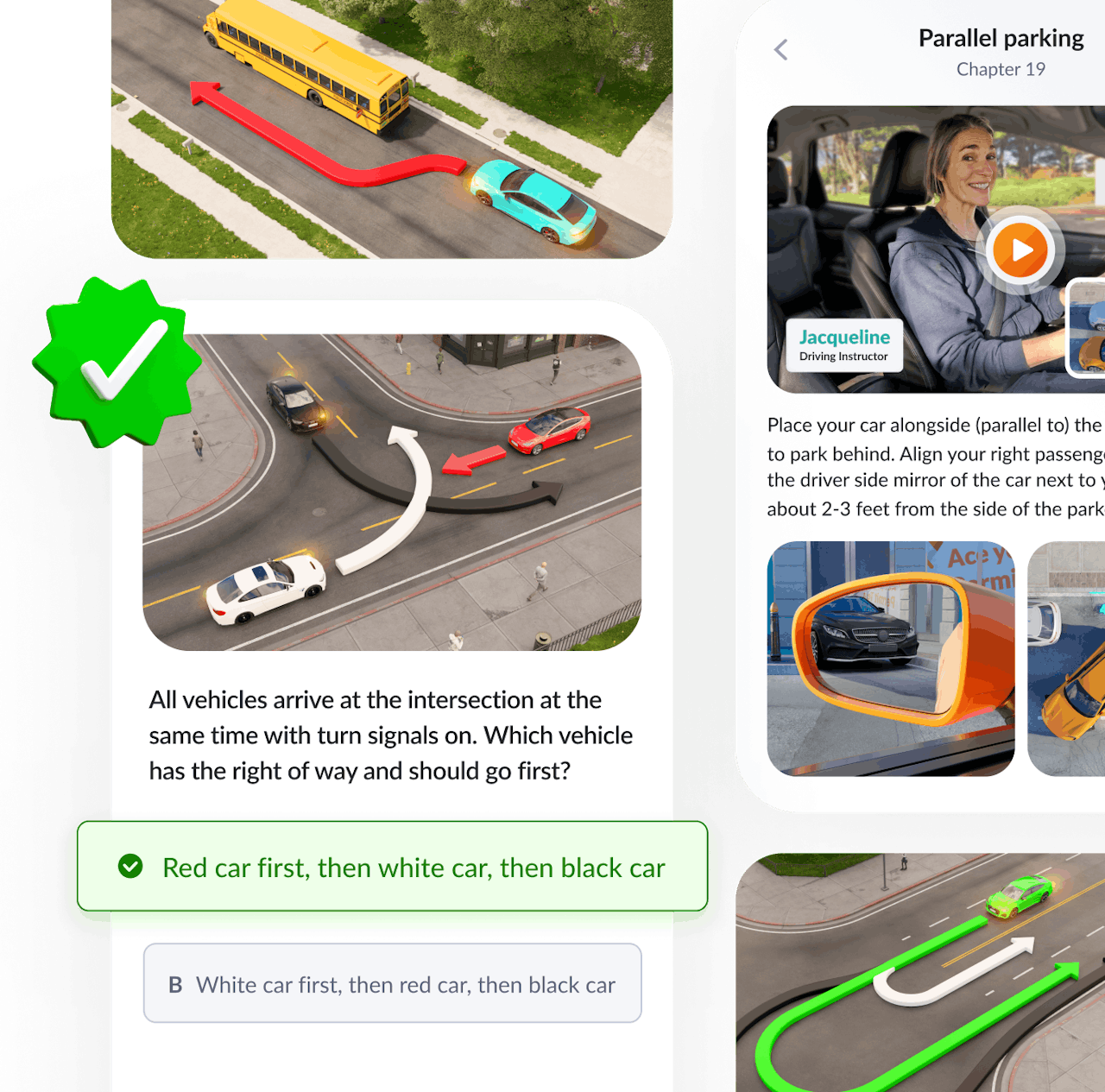
Take our full course with tests and theory
600+ exam-like questions and practice tests
Easy summarized DMV handbook
America’s #1 driver’s ed app with a 95.8% pass rate
Recommended articles


Ace your DMV test, guaranteed
Want to Be the Top School in Your Area?

- Simple & automated admin
- More time for teaching
- #1 learning materials for students
Start learning now
Resources
- Driver’s License Renewal
- How to Get Your US Driver’s License
- How to Prepare for Your Road Test
- How to Get a Driver’s Permit
- Behind-The-Wheel training
- Courses
- Blog
- FAQ
Show More


©2026 Zutobi AB, 4 Peddlers Row, Unit #103, Newark, DE 19702