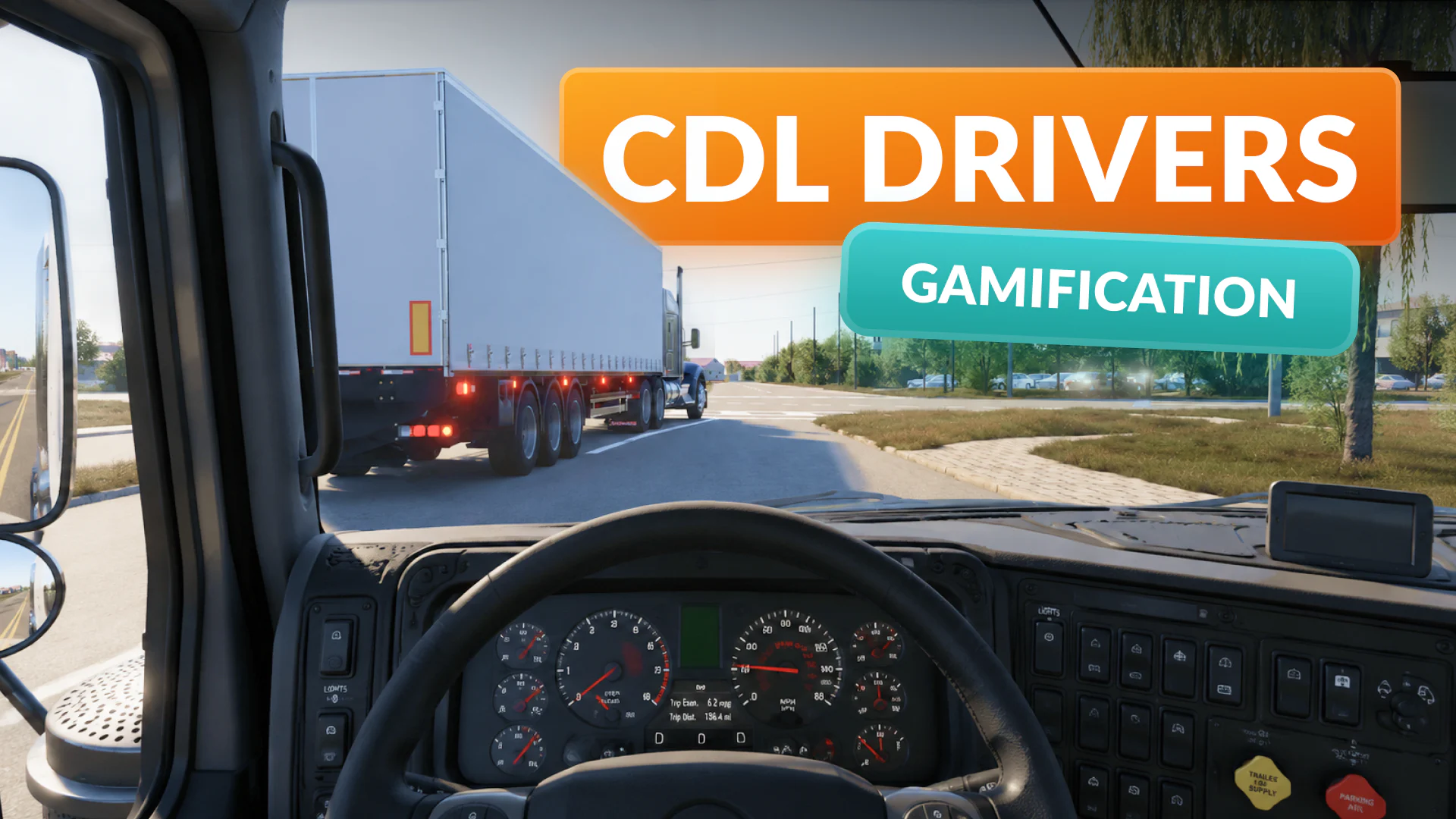
60% of American Adults Game Every Week. So, Why Are We Still Handing CDL Candidates a PDF?

Picture the typical CDL candidate, and the industry tends to imagine someone who wants serious, no-nonsense study materials. A manual that feels appropriate. That intuition has shaped CDL prep for decades, and it is built on a picture of adult learners that simply does not reflect reality anymore.
Who is actually sitting for a CDL test?
In 2025, 60% of American adults play video games every week. The average player is 36 years old. The average adult player has been gaming for 17 years. Nearly half of Boomers, people between 61 and 79, play weekly. These numbers come from the Entertainment Software Association’s 2025 Essential Facts About the U.S. Video Game Industry, the most comprehensive annual survey of gaming behavior in the country.
So, gaming is not a youth habit, but is an adult norm. And the industry handing new CDL candidates a dense PDF has not caught up to that.
The average age of a U.S. truck driver is 47, according to ATRI’s 2024 demographic report. That is precisely the cohort the ESA data describes when it says the average gamer is 36 and has been playing for 17 years.
The person preparing for their CDL knowledge test is, statistically, someone who already understands progress bars and point systems. They use them for entertainment every week. The assumption that game-based learning would feel out of place for this person is the opposite of what the data shows.
Does gamification work for adult learners? (Yes, and here is the proof)
This is the question worth asking directly, because the answer is specific and well-documented.
A three-year longitudinal study by researchers Georgios Lampropoulos and Antonis Sidiropoulos, published in Education Sciences in April 2024, tracked 1,001 higher education students across three learning formats: online learning, traditional classroom instruction, and gamified learning.
Gamified learning produced a 39% higher success rate, 42% better knowledge retention, and a 130% higher excellence rate compared to online learning. Compared to traditional classroom instruction, the gaps were still significant: a 13% higher success rate and a 36% improvement in retention.
Gamified learners were more likely to stay in the course, more likely to pass, and more likely to do so with a strong result.
For CDL candidates, this matters because the CDL knowledge test covers federal and state-specific regulations, hazardous materials, vehicle inspection procedures, and safe driving practices. It is not light material. Retaining it well enough to pass a test under pressure requires exactly the deep encoding that gamified learning produces.
What changes when the method matches the learner
Gamified CDL prep is not about making regulation feel like a cartoon. It is about structuring the learning loop so that people actually complete it.
The mechanics that work are specific:
- Immediate feedback after every question, with explanations, means learners understand what they got wrong and why.
- Visible progress tracking means there is always a clear answer to “how far have I come.”
- Practice modes let learners focus on the questions that have tripped up others the most, so their study time goes where it is needed.
- Short, focused lessons mean study sessions fit into the real schedules of adults who are also working, applying for jobs, or managing families.
The content accuracy matters equally. CDL knowledge tests are state-specific. A gamified platform built on outdated or generalized questions misleads candidates into false confidence. The method and the content have to both be right.
Zutobi: the platform that already solved this
Zutobi is the CDL prep platform built around exactly this problem. It is certified to issue Entry Level Driver Training (ELDT) certification to the FMCSA’s Training Provider Registry, which means it sits inside the official CDL pathway, not outside it.
The platform includes over 950 CDL-specific questions, state-specific content aligned to current FMCSA requirements, and a learning structure built around the same science cited above: immediate feedback, visible progress, point systems, level progression, and bite-sized lessons designed for the schedules of adult learners. The lessons combine written material with visual and video-based instruction, engaging multiple learning channels simultaneously.
For someone entering the CDL pipeline, the choice of prep tool directly affects their pass rate and the confidence they carry into the rest of their training. A platform that keeps learners engaged, adapts to their progress, and prepares them accurately for state-specific content is the method the science recommends.
FAQ
Does gamification improve learning outcomes for adults, or is it just for kids?
The method works regardless of age. A three-year study of 1,000+ students published in Education Sciences (MDPI, 2024) found gamified learning produced a 39% higher success rate and 42% better knowledge retention than online learning.
What specific mechanics make gamified CDL prep more effective than a standard practice test?
A gamified platform gives immediate explanatory feedback on each question, shows a visual progress bar, awards points for correct answers, and structures content into short sessions that fit around adult schedules. Individually, each of these is a small change. Together, they produce the low-friction engagement that turns short-term study into durable knowledge.
Is gamified learning appropriate for the seriousness of CDL regulations and safety content?
Yes. They do not make the material less serious. They make learners more likely to complete and retain it. CDL knowledge tests cover genuinely complex regulatory material: hazardous materials handling, vehicle inspection, hours-of-service rules, and state-specific traffic law. Engaging learners deeply with that content through a gamified format produces more prepared drivers, not less serious ones.
How does Zutobi approach CDL prep differently, and is it officially recognized?
Zutobi is certified to issue Entry Level Driver Training (ELDT) certification to the FMCSA’s Training Provider Registry, placing it inside the official CDL licensing pathway. The platform includes 950+ state-specific CDL questions, gamified learning mechanics including points, leaderboards, and level progression, and video-led lessons. It is a science-backed, federally recognized prep platform built for the specific demands of CDL training.

850+ exam-like questions
All you need to ace your endorsement tests
We are certified to issue Entry Level Driver Training (ELDT) certification to the TPR for CDL drivers.
Recommended articles

Ace your DMV test, guaranteed
Want to Be the Top School in Your Area?

- Simple & automated admin
- More time for teaching
- #1 learning materials for students
- Driver’s License Renewal
- How to Get Your US Driver’s License
- How to Prepare for Your Road Test
- How to Get a Driver’s Permit
- Behind-The-Wheel training
- Courses
- Blog
- FAQ
Show More


