loved by
15.1+ million
users

Learning to Drive Later in Life: Why More US Adults Are Starting at 30, 40, and Beyond, and What Helps Them Pass

The DMV testing room is no longer the territory of 16-year-olds alone. More US adults than ever are starting from scratch in their thirties, forties, and fifties, or returning to the test after years of letting a license lapse. They face the same exam as a teenager, but with very different brains and very different pressures on their time.
A November 2024 Pew Research Center analysis found that 10% of Americans are nondrivers, including 6% who say they don’t drive at all. Among adults aged 30-49, the figure is 9%. The share climbs to 19% among lower-income households and 18% among urban residents.
That is millions of working-age Americans, most of them well past the typical teenage licensing window, who either never got a license or stopped using one. When life circumstances change, a new job in the suburbs, a move, a family, this is the population that walks back into the DMV. And they walk in as adults.
Who is the modern adult learner?
- New US residents and immigrants facing a state DMV for the first time, often in a language that is not their first.
- Adults who skipped a license as teenagers because of city living, cost, family circumstances, or because they did not need one at the time.
- Returning drivers who held a license once, let it expire, and now have to retest after a long gap.
- Partners and parents who relied on someone else to drive for years and now need their own license back.
The two real obstacles adults face, and what the research says
The “I’m too old to learn this” myth
One of the most common things adult learners say: “I should have done this when I was younger.” They believe that older brains have lost the ability to take in new structured material the way a teenager can. The research says that belief is wrong.
In a 2026 review published in the American Psychological Association’s Monitor on Psychology, researchers documented that adults retain a strong capacity to learn new skills into later life, especially when material is delivered through effective learning strategies, such as breaking tasks into steps and allowing people to practice what they have learned.
The same cognitive systems adults use for problem-solving and pattern recognition at work are the ones they use to learn the rules of the road. They have not weakened. They just respond better to a different kind of instruction than a teenager’s brain does.
The “I’ll be the only adult in the room” stereotype
The second belief that keeps adults out of the DMV is embarrassment. Walking into a testing center at 35 or 45, surrounded by 16-year-olds with their parents, feels like showing up to a milestone you were supposed to have hit twenty years ago. For many adult learners, this is the real reason the license keeps getting pushed to next year.
The shame is based on a stereotype that does not match the data. As noted earlier, the Pew Research Center found that 9% of US adults aged 30-49 are nondrivers. That is millions of people. The 35-year-old at the DMV is not the exception. Most testing centers see adult first-time applicants every single week.
What an adult-friendly study approach looks like
If the science says adults learn well with short stepwise sessions and active practice, then the question is what a permit prep tool needs to do to deliver that. There are five things, and they line up directly with what is missing from a traditional DMV handbook:
- Short, focused sessions that fit between work, kids, and a commute.
- Visual and audio input together, not text alone, because the brain encodes information better through more than one channel.
- Immediate practice after each concept, not pages of reading before any retrieval happens.
- Format familiarity with the real test, so anxiety does not eat up working memory on the day.
- Current state-specific content, because laws change every year, and outdated material is worse than no material.
Zutobi is built around these principles for the US permit test with a video handbook and state-specific driving simulations. Each chapter ends in a quiz, so practice happens immediately. And it has an exam simulator that mirrors the exact format of each state’s DMV test, so by the time an adult walks into the testing room, the structure is familiar.
The returning driver: a separate case worth its own attention
There is a second group of adults who often get lumped in with first-time learners, but should not be. These are returning drivers: people who held a license once, let it lapse, and now have to retest. This happens after long gaps abroad, after moves between US states with stricter retesting rules, after years in a major city without a car, or after a license suspension.
This group has a specific blind spot. They think they know how to drive, and they do. But the rules they learned ten or twenty years ago are not the rules being tested today. Hands-free phone laws have changed in most states, and right-of-way rules around bike lanes and roundabouts have been updated. Returning drivers walk into the DMV confident, fail on questions they assumed they knew, and then have to come back.
This is where a question bank that gets updated annually based on new laws is a must. Zutobi’s question bank is reviewed and refreshed every year against current state laws, which is what a returning driver needs more than anything else.
What learning to drive later in life actually takes
The adult learner in America is not someone who fell behind. They are someone whose life did not need a car at 16, and now does. The research is detailed that adults retain the capacity to learn this well, and the data shows they are far from alone in that DMV room. What changes the outcome is the method.
Zutobi is built exactly for that. For an adult studying between work and family, that is the difference between months of effort and a clean pass.
FAQ
Am I too old to learn to drive? No. Research from the American Psychological Association shows adults retain a strong capacity to learn structured skills like driving rules well into later life, especially when material is delivered in short steps with practice.
How long does it take an adult to pass the permit test? It depends on how often you study, but most adults using a structured app like Zutobi prepare in two to four weeks of short daily sessions.
Is the permit test different for adults than for teens? The test itself is the same. The questions and the passing score do not change by age. The change is in how much study time most adults have, which is why the format of the material matters more than its content.
I had a license that expired. Do I have to retest? It depends on your state and how long it has been expired. Many states require returning drivers to retake the written test after a long lapse, and the rules have likely changed since you last studied. A question bank updated for current laws is what this group needs most.
Is Zutobi available for adult learners, or just teens? Zutobi works for any learner preparing for a state DMV permit test. Adults use it the same way teens do: state-specific handbook, video lessons, quizzes after each chapter, and an exam simulator that matches the real test format.
What if English is not my first language? Most state DMVs offer the written permit test in multiple languages. Zutobi’s video format also makes the material easier to absorb than dense text, which helps adult learners who are studying in a second language.
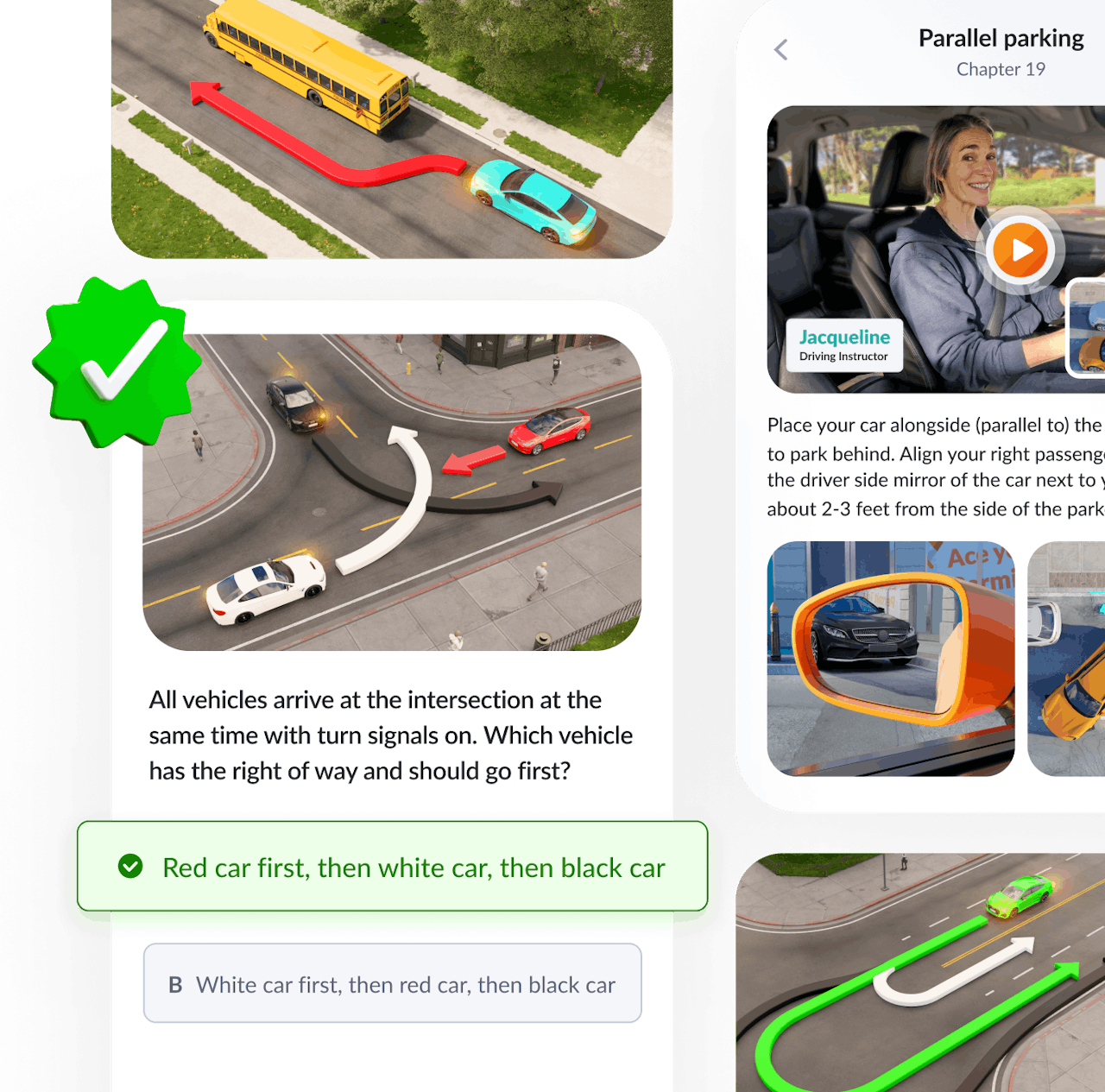
Take our full course with tests and theory
600+ exam-like questions and practice tests
Easy summarized DMV handbook
America’s #1 driver’s ed app with a 95.8% pass rate
Recommended articles

Ace your DMV test, guaranteed
Want to Be the Top School in Your Area?

- Simple & automated admin
- More time for teaching
- #1 learning materials for students
Start learning now
Resources
- Driver’s License Renewal
- How to Get Your US Driver’s License
- How to Prepare for Your Road Test
- How to Get a Driver’s Permit
- Behind-The-Wheel training
- Courses
- Blog
- FAQ
Show More


©2026 Zutobi AB, 4 Peddlers Row, Unit #103, Newark, DE 19702