loved by
15.1+ million
users

Oregon Driving Test Pass Rates: The Fail Rate Has Nearly Doubled Since 2021 (Official DMV Data)

This report breaks down official Oregon DMV data year by year (2015–2025), explains why Oregon’s road test fail rate has been climbing, and shows you exactly how to pass on your first attempt.
Data source: Oregon Department of Transportation / Driver & Motor Vehicle Services, drive test records covering non-commercial Class C tests, 2015–2025.
Oregon Driving Test: What 11 Years of Official Data Tells Us
How many people take the Oregon road test each year?
Between 2015 and 2025, Oregon administered 847,691 driving tests, roughly 77,000 per year on average. Volume has swung significantly across the decade, bottoming out at 49,374 tests in pandemic-affected 2020 before surging to a record high of 97,499 in 2021, as pent-up demand flooded DMV offices all at once. Since that peak, annual volumes have settled back into the mid-to-high 80,000s, with 2025 coming in at 82,733.
What is the Oregon driving test pass rate?
Over the full eleven-year period, Oregon’s overall pass rate sits at approximately 82.6%.
| Metric | Number | Rate |
| Total road tests taken (2015–2025) | 847,691 | — |
| Total passed | ~699,967 | ~82.6% |
| Total failed | ~147,724 | ~17.4% |
Source: Oregon DMV / ODOT drive test records, 2015–2025.
Is a 21% fail rate actually high for Oregon?
By Oregon’s own historical standards, yes. As recently as 2019, only 14% of test-takers failed, roughly 1 in 7. In 2025, that figure is 21%, meaning more than 1 in 5 people who show up for their Oregon road test leaves without a license.
And there’s a caveat that makes the real picture even starker. The DMV data doesn’t separate first-attempt takers from retakes. A meaningful share of the recorded passes came from people testing a second or third time. If you’re walking in for the first time, your actual odds of passing are almost certainly lower than the headline 79% suggests.
Year-by-year breakdown (full data table)
| Year | Tests Given | Passed | Failed | Pass Rate | Fail Rate |
| 2016 | 67,988 | 54,781 | 13,207 | 81% | 19% |
| 2017 | 62,253 | 53,091 | 9,162 | 85% | 15% |
| 2018 | 54,415 | 46,496 | 7,919 | 85% | 15% |
| 2019 | 56,190 | 48,045 | 8,145 | 86% | 14% |
| 2020 | 49,374 | 41,214 | 8,160 | 83% | 17% |
| 2021 | 97,499 | 84,845 | 12,654 | 87% | 13% |
| 2022 | 79,725 | 66,529 | 13,196 | 83% | 17% |
| 2023 | 88,602 | 73,196 | 15,406 | 83% | 17% |
| 2024 | 88,607 | 72,183 | 16,424 | 81% | 19% |
| 2025 | 82,733 | 65,427 | 17,306 | 79% | 21% |
Source: Oregon DMV / ODOT drive test records, 2016–2025.
Three things stand out in the year-by-year data.
2021 was the easiest year to pass in over a decade. With a backlog of candidates finally clearing after pandemic disruptions, many of whom had months of extra preparation time during lockdowns, the pass rate peaked at 87%. That’s the best single-year result in the entire dataset, and it now looks like an outlier.
The fail rate has climbed every single year since 2021. From 13% in 2021 to 21% in 2025, Oregon’s road test has become measurably harder to pass for four consecutive years. That is not a blip. It is a consistent, sustained trend.
2025 is the hardest year to pass in the modern record and the numbers are more alarming than the percentage alone suggests. A 21% fail rate is the worst result in eleven years of data. More than 17,000 Oregonians failed their driving test in 2025 alone, the highest absolute failure count ever recorded. And here is the most telling detail: total tests actually fell by 15% between 2021 and 2025, yet the number of people failing rose by 37%. Fewer people are taking the test, and more of them are leaving without a license.
Why Is Oregon’s Driving Test So Hard to Pass Right Now?
What Oregon DMV examiners actually score
The test doesn’t measure your ability to operate a vehicle. It measures whether you can demonstrate specific behaviors in a specific sequence, under observation.
Those behaviors include:
Observation checks. Visible mirror and shoulder checks before every lane change, turn, and merge. If the examiner can’t see you looking, it didn’t happen.
Lane changes. Signal, mirror, blind spot, smooth execution — in that order. Miss any one step and points come off.
Intersections. Correct right-of-way at 4-way stops, complete stops behind the limit line, and proper yielding on unprotected left turns.
Speed control. Staying within the posted limit, smooth and progressive braking, consistent speed through curves.
Parking. Parallel parking, hill parking with correct wheel position, and safe pull-outs from the curb.
The preparation gap is getting wider
Oregon requires teen drivers to complete 100 hours of supervised driving before a provisional license — 50 hours if they completed an approved driver education course. That is a high bar on paper. In practice, hours logged without structure or deliberate focus do far less to build the specific skills examiners score. A candidate who has driven 100 hours on familiar routes without deliberately practicing lane changes, unprotected lefts, or parallel parking is less prepared than that hour count implies.
Oregon also introduced online knowledge testing in October 2023 and revised all test questions at the same time. Greater accessibility to the written test may have allowed less-prepared candidates to reach the road test stage sooner — which is consistent with the continued rise in fail rates through 2024 and 2025.
The pool of test-takers has also shifted since the unusual 2021 wave. That peak year brought an exceptional cohort: people who had waited out the pandemic and arrived with more preparation time than normal. As that group worked through the queue, the pattern normalized and the fail rate rose to reflect it.
How to Pass the Oregon Driving Test on Your First Try
1. Make your observation checks visible. Oregon examiners must see you look, not just know that you looked. Before every lane change, turn, and merge, move your head deliberately enough that the examiner can observe you checking your mirrors and blind spots. This is the single most common source of deducted points, and it’s entirely within your control.
2. Practice unprotected left turns until the decision is automatic. Unprotected lefts are consistently among the top failure points on the Oregon road test. You need to correctly read who has right-of-way, yield when you don’t, and complete the turn into the correct lane — all under time pressure. That level of fluency only comes from repetition in real traffic, not from reading the rule once.
3. Learn the rules in context, not just on paper. Oregon’s right-of-way rules trip up a huge number of test-takers. Reading a rule is not the same as recognizing it when you’re behind the wheel with an examiner next to you. Deep understanding comes from seeing rules play out in real scenarios, so your brain builds a reference point for what correct looks like.
4. Structure each practice session around one skill. Aimless “let’s go drive for an hour” time is far less effective than a focused 30-minute session working on one specific behavior. Spend one session on lane changes. Spend the next on 4-way stop decisions. Work through parking maneuvers separately. Deliberate, targeted practice beats seat time.
5. Give your parent-supervisor a framework. For most Oregon teens, a parent or guardian is the primary practice partner in the months before the road test. Unstructured supervision can reinforce bad habits as easily as it builds good ones. A clear, skill-by-skill curriculum is what separates practice that actually prepares you from practice that wastes time.
What Is the Best App to Prepare for the Oregon Driving Test?
Most driver’s ed apps help you prepare only for the written permit test. Fewer are built around what you actually need for the road test: understanding how traffic rules work in real scenarios. Zutobi is designed specifically for both.
Zutobi is the only US driver’s ed app with a video-led handbook
Zutobi teaches every Oregon road rule through short, narrated video lessons with visual demonstrations. You see each scenario play out — right-of-way at a 4-way stop, merging onto a highway, yielding on an unprotected left turn — and hear the explanation at the same time. That combination of visual and audio input builds a deeper understanding than reading alone.
A step-by-step parent-teen training guide built by a certified instructor
For most Oregon teens, a parent is the primary practice partner before the road test. In October 2023, the Governors Highway Safety Association (GHSA) published “Young Drivers and Traffic Fatalities: 20 Years of Progress on the Road to Zero”, authored by former NHTSA official Dr. Jim Hedlund and Pam Shadel Fischer. Analyzing two decades of federal Fatality Analysis Reporting System data, the report found that parental involvement was one of the key factors behind a 38% drop in fatal crashes involving young drivers, and directly recommended that states build parent driver education into their licensing requirements.
Zutobi’s Parent-Teen Training Guide, gives California families a complete curriculum: from basic car controls through residential streets, intersections, arterials, and freeways. Every level includes specific skills to practice and the exact mistakes to watch for, so supervised practice actually prepares teens for what California examiners score.
FAQ: Oregon Driving Test
What is the pass rate for the Oregon driving test? The statewide pass rate in 2025 is 79%, based on 82,733 tests administered. That means roughly 1 in 5 test-takers fails — up from 1 in 8 just four years ago in 2021. Across the full eleven-year dataset from 2015 to 2025, the overall pass rate is approximately 82.6%.
Is the Oregon driving test getting harder? The data shows a clear trend: Oregon’s road test fail rate has risen every year since 2021, reaching 21% in 2025 — the highest in the modern dataset. The test’s scoring criteria haven’t changed dramatically, but the combination of a shifted test-taker pool, increased accessibility to the written test, and less structured preparation has made passing on the first attempt measurably harder.
How many people fail the Oregon driving test each year? In 2025, 17,306 Oregonians failed their driving test, the highest number on record. Across the full dataset from 2015 to 2025, approximately 119,800 people failed the Oregon road test.
What are the most common reasons for failing the Oregon driving test? The most common failure points are: incomplete or non-visible observation checks (mirror and shoulder checks before lane changes and turns), errors at intersections — particularly right-of-way decisions at 4-way stops and unprotected left turns — improper speed control, lane change procedure errors, and mistakes during parking maneuvers. Test anxiety is a significant factor behind many of these errors.
What’s the best way to study for the Oregon driving test? The most effective preparation combines rule knowledge with visual learning, watching traffic situations play out correctly so you have a real reference for what the examiner expects. The Zutobi app has a video-led handbook: every California rule is taught by a professional driving instructor through a short video, so you’re watching real scenarios unfold.
How should parents structure practice sessions? Effective practice sessions have one specific focus per session and build progressively: start with fundamentals in empty parking lots, move to residential streets, then busier roads and intersections, and finally highway driving and multi-lane arterials. Zutobi’s Parent-Teen Training Guide gives Oregon parents a complete step-by-step curriculum designed by a certified driving instructor.
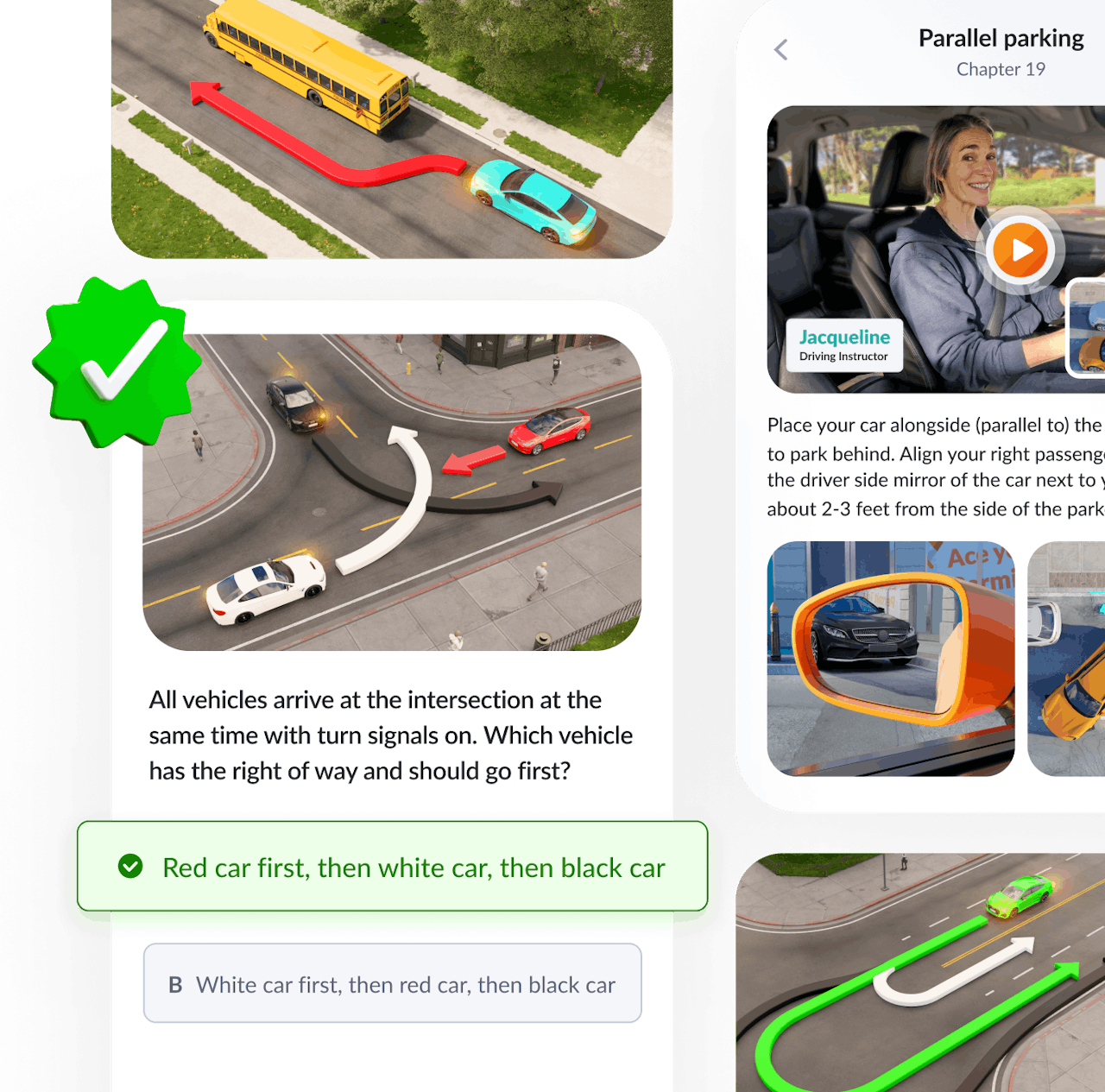
Take our full course with tests and theory
600+ exam-like questions and practice tests
Easy summarized DMV handbook
America’s #1 driver’s ed app with a 95.8% pass rate
Recommended articles

Ace your DMV test, guaranteed
Want to Be the Top School in Your Area?

- Simple & automated admin
- More time for teaching
- #1 learning materials for students
Start learning now
Resources
- Driver’s License Renewal
- How to Get Your US Driver’s License
- How to Prepare for Your Road Test
- How to Get a Driver’s Permit
- Behind-The-Wheel training
- Courses
- Blog
- FAQ
Show More


©2026 Zutobi AB, 4 Peddlers Row, Unit #103, Newark, DE 19702