loved by
15.1+ million
users
Top 7 Florida Permit Test Pitfalls New Drivers Keep Falling Into in 2026 (And How to Avoid Each One)

Failing the Florida permit test usually isn’t about being a bad student. It’s about falling into one of seven very predictable traps, most of them avoidable in a week of smart study.
Florida’s knowledge exam has 50 multiple-choice questions, and learners need 40 correct (80%) to pass. The test ends automatically the moment they hit 40 right answers, or the moment they rack up 11 wrong ones.
The team at Zutobi, a permit prep app used by over 10 million learners across the US, pulled together the seven pitfalls tripping up Florida test-takers the most. Here’s what to watch for, and exactly how to avoid each one.
Pitfall 1: Treating the 104-Page Florida Driver Handbook as the Only Study Tool
The official Florida Driver Handbook is 104 pages long. Most of it isn’t tested: vehicle registration steps, insurance details, DMV office logistics, license renewal procedures. By the time learners wade through that, they’ve used up their mental energy on content the exam doesn’t care about.
This is how the brain works. According to Sweller, van Merriënboer, and Paas (2019) in their landmark review of Cognitive Load Theory in Educational Psychology Review, when the brain is loaded with irrelevant information, the cognitive bandwidth left for what actually needs to stick gets reduced. In other words, every page of unrelated content a learner reads makes it harder to remember the rules they’ll actually be tested on.
How to avoid it: New drivers should focus only on what’s tested: Florida traffic laws, road signs, right-of-way rules, safe driving practices, and the Move Over Law. This is where permit prep apps come in handy, because they’ve already done the hard part of separating what’s on the test from what isn’t. Zutobi, for example, condenses the 104-page Florida handbook into short chapters that only cover what shows up on the exam.
Pitfall 2: Studying Old Material from Before Florida’s 2024 and 2025 Law Changes
Florida traffic law has changed three times in the last two years, and yes, the new rules show up on the exam.
- The Move Over Law was expanded on January 1, 2025: drivers now have to move over for any vehicle on the side of the road with hazard lights, flares, or warning signs, not just police, tow trucks, or ambulances.
- The 6-hour DETS course replaced the 4-hour TLSAE course for all new applicants under 18 on August 1, 2025. Adults 18+ who have never held a license still take TLSAE.
- Enhanced handheld-device penalties in school and work zones took effect July 1, 2025, with fines up to $500 for a first offense and license suspension for repeat violations.
If learners are studying a guide written before mid-2025, they’re rehearsing the wrong answers.
How to avoid it: Use prep material that’s updated annually and reflects current Florida law, not a generic national database from three years ago.
Pitfall 3: Memorizing Answers Instead of Understanding the “Why”
Florida’s Class E exam doesn’t just ask learners to recognize a fact. It asks them to apply a rule to a scenario. “What should a driver do if they see a tow truck stopped on the shoulder with hazards on?” is not the same as “What is the Move Over Law?” If a learner memorized a definition but never understood the reasoning, they’ll freeze when the wording shifts.
How to avoid it: After every concept they study, learners should quiz themselves before moving on. Don’t just read, recall. And when they get a question wrong, they should read the explanation of why the right answer is right.
Pitfall 4: Underestimating Road Signs and the Move Over Law
Two categories often trip up test-takers: similar-looking road signs and right-of-way scenarios, especially Move Over situations. Both are heavily emphasized in the official FLHSMV Class E Knowledge Exam content, which is drawn directly from the Florida Driver’s License Handbook.
And there’s a clear reason these areas matter so much in Florida. According to AAA, Florida became the 17th state in the country to require drivers to move over for any disabled vehicle on the roadside when HB 425 took effect on January 1, 2024, a rule that trips up people who studied for a generic national test.
How to avoid it: Learners should drill these two categories separately, not mixed in with everything else. If they can isolate “road signs only” and “right-of-way only” practice and work them until they score 90%+, the rest of the test gets a lot easier.
Pitfall 5: Cramming the Night Before Instead of Spacing Sessions
This is the single most common mistake, and it has nothing to do with the material. A person can know every rule in the handbook on Tuesday night and forget half of it by Wednesday morning, because cramming doesn’t move information into long-term memory.
The fix is called spaced retrieval, and the evidence is overwhelming. In the 2022 Nature Reviews Psychology meta-analysis by Carpenter, Pan, and Butler, students who studied the same content in short, spaced sessions over several days outperformed crammers both two weeks later and a full year later.
How to avoid it: Test-takers should break their study into 10 to 15-minute sessions across at least 5 to 7 days before the test.
Pitfall 6: Walking In Without Ever Seeing the Test Format
Learners can know the material and still fail if the format catches them off guard. Florida gives them 1 hour for 50 questions. The test ends automatically once they hit 40 right or 11 wrong, and they only get three attempts at the online version before they have to come in person. If a learner has never sat through that exact structure, their brain spends mental energy processing the unfamiliar, instead of recalling answers.
There’s a name for this. Cassady, Helsper, and Quagliano (2024), in a study of 853 university students published in Behavioral Sciences, showed that test anxiety directly hijacks working memory during an exam. When learners don’t know what’s coming, their brain is solving two problems at once: navigating the format and recalling content. Neither gets full attention.
How to avoid it: Learners should take at least 3 to 5 full-length practice tests in the exact Florida format: 50 questions, 80% pass threshold, and one hour. By test day, the format should feel familiar, not new.
Pitfall 7: Skipping the DETS Course Content Because It Feels Separate
For under-18 applicants, Florida requires the 6-hour Driver Education Traffic Safety (DETS) course before the permit test. Many teens treat this as a checkbox, and that’s a mistake.
DETS covers exactly the topics that show up on the Class E exam: DUI penalties, implied consent, the point system, and Florida’s specific BAC limits.
How to avoid it: Treat the DETS material as test prep, not a formality. The same rules that show up on the exam are the ones that keep new drivers out of trouble on the road.
How to Prepare the Right Way: The 4-Step Method That Actually Works
The seven pitfalls all point to the same underlying problem: most learners study using one method (reading) and one format (the handbook) and hope it sticks, but it doesn’t.
What works is a four-step sequence that uses how the brain actually learns:
- Learn the concept in a focused, filtered way, only what’s tested, no filler.
- Watch it demonstrated visually, so the brain processes it through two channels at once (visual and audio).
- Practice with quizzes after each chapter, short, spaced, with immediate feedback. This is retrieval practice in action.
- Simulate the real exam in the exact Florida format until learners consistently score 90%+. This is the step that kills test-day anxiety.
Is There an App That Covers All 4 Steps? Zutobi
Most permit prep apps cover one step. Zutobi is the only U.S. permit prep app built around all four steps in sequence, and built specifically for Florida.
Here’s what that looks like:
- Step 1, Learning: A summarized version of the Florida handbook, stripped down to only what’s on the Class E exam.
- Step 2, Watching: Zutobi is the only U.S. permit app where every chapter is taught through video lessons with visual demonstrations.
- Step 3, Practicing: 600+ Florida-specific questions, instructor-verified, updated annually to reflect current Florida law, with a gamified format that keeps learners coming back for 10- to 15-minute sessions.
- Step 4, Simulating: A Florida-format exam simulator with exactly 50 questions, an 80% pass threshold, and the same topic mix as the real Class E exam. Unlimited retakes with detailed explanations for every wrong answer.
The Florida permit test isn’t so easy, but it rewards the people who studied the material in the right format, with enough repetition to make it stick. Learners who avoid the seven pitfalls above and follow the four steps will walk out with a permit.
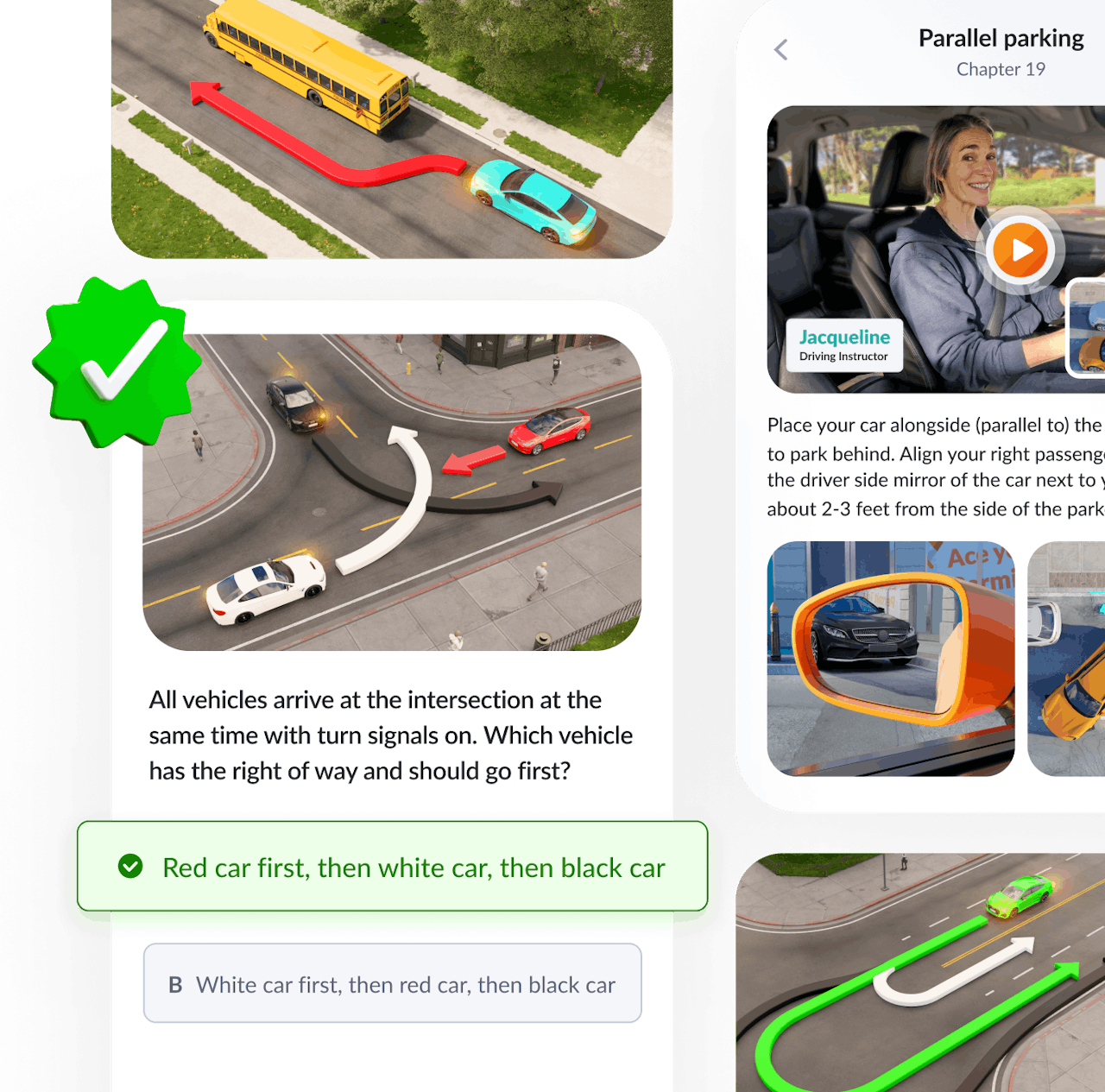
Take our full course with tests and theory
600+ exam-like questions and practice tests
Easy summarized DMV handbook
America’s #1 driver’s ed app with a 95.8% pass rate
Recommended articles

Ace your DMV test, guaranteed
Want to Be the Top School in Your Area?

- Simple & automated admin
- More time for teaching
- #1 learning materials for students
Start learning now
Resources
- Driver’s License Renewal
- How to Get Your US Driver’s License
- How to Prepare for Your Road Test
- How to Get a Driver’s Permit
- Behind-The-Wheel training
- Courses
- Blog
- FAQ
Show More


©2026 Zutobi AB, 4 Peddlers Row, Unit #103, Newark, DE 19702