loved by
15.1+ million
users

Why 35% of Americans Fail Their Permit Test: 7 Pitfalls Tripping Up New Drivers

The permit test looks easy on paper. The numbers tell a different story. Between 2020 and 2023, only 61.7% of Americans passed the written knowledge test on their first attempt, according to a USA Today analysis of data gathered directly from 36 state DMVs.
So why are so many learners walking out of the DMV empty-handed? The answer rarely has to do with intelligence or effort. It comes down to how they prepare.
Below are the seven most common pitfalls tripping up new drivers, along with how a single learning system addresses each one.
Pitfall #1: Trying to Memorize the Entire Handbook
Every state defaults to the same study material: the official DMV handbook. But handbooks typically run 100 to 130+ pages, and most of that content never appears on the test. Learners open the handbook and either give up or end up studying the wrong material.
This is a cognitive load problem. In their updated review of Cognitive Load Theory, Sweller, van Merriënboer, and Paas (2019) showed that when learners are forced to process unnecessary content, working memory gets eaten up by irrelevant information, leaving less capacity for what actually matters.
Put simply, the more filler a learner has to wade through, the harder it becomes for their brain to encode the rules that will actually be tested.
The fix: Effective prep focuses on a summarized version of the handbook, organized into chapters paired with visuals of real driving scenarios.
Pitfall #2: Studying With Text Only
Most prep apps still treat permit study like a textbook: read the chapter and answer the questions. The problem is that reading dense traffic-rule text uses only one input channel and gives the brain very little to work with.
A 2022 randomized trial at Government Medical College, Aurangabad, split 100 students into a video group and a text group. By week four, the video group scored 7.38 out of 10 versus 6.48 for the text group. A meaningful gap, and one that grew over time rather than shrinking.
The fix: Moving learning away from walls of text and toward videos. When a learner sees the scenario and hears the explanation at the same time, the brain processes the concept through two channels, building two connected mental models. The result is a deeper understanding and stronger memory.
Pitfall #3: Studying Without a Motivation System
Permit prep is a chore. Nobody wakes up excited to study right-of-way rules. When something feels like a chore, learners procrastinate and lose motivation. The fix is a system that builds motivation in, instead of asking learners to manufacture it themselves.
Challenge-based gamification has a measurable effect on learning, and there’s a clear neuroscience explanation for why. Dopamine neurons fire reward signals when someone receives a small reward they didn’t fully expect, and that signal trains the brain to repeat the behavior that led to it. Every time a learner finishes a chapter and levels up, the brain sends the message: “That felt good, do it again”.
The fix: Replacing willpower with built-in motivation. A study system that awards points and shows a visible progress bar triggers what researchers call the goal-gradient effect, where people accelerate their effort as they near the finish line.
Pitfall #4: Cramming
The classic prep strategy is to do nothing for weeks, then read the handbook in one long session the night before. It rarely works because cramming creates short-term familiarity, not long-term memory.
A 2022 review in Nature Reviews Psychology by Carpenter, Pan, and Butler identified the two most powerful strategies for long-term retention: learning in small doses over time and actively recalling information rather than re-reading it. Students who used both performed better and faster on tests 2 weeks and 1 year later.
The takeaway: it isn’t about how much time a learner puts in. It’s about how that time is distributed, and whether they’re actively pulling information from memory.
The fix: Short, repeated study sessions with built-in retrieval. Each session should cover one focused topic and end with a quiz that forces the learner to recall what they just studied. 10-15-minute sessions spread across days or weeks consistently outperform marathon reading.
Pitfall #5: Studying Generic, Outdated, or Non-State-Specific Questions
This pitfall trips up adults more than teens. The internet is full of free permit practice tests, and on the surface, they all look fine. But many of them use outdated questions, generic national content, or material that doesn’t match the test the learner will take.
The rules change every year. New phone restrictions, updated BAC limits, revised speed zones. If the study material is two years old, the learner is preparing for last year’s test.
The fix: Using a question bank built by people who know what’s on the specific state test. The strongest banks are written by certified driving instructors.
Pitfall #6: Practicing Only One Topic at a Time
This pitfall feels counterintuitive because it looks like good studying: drill all the right-of-way questions, then move to parking. But the real test doesn’t work that way.
The DMV mixes question types randomly. A learner won’t get a block of right-of-way questions followed by a block of parking questions. They’ll get one, then the other, then something else, all jumbled. If they’ve only studied in blocks, their brains haven’t been trained to recognize what kind of question they’re looking at before they can answer it.
The fix: Mixing the practice. Drilling a single topic helps when there’s a clear weak spot, but most of the study time should pull questions from every category at once.
Pitfall #7: Walking Into the DMV Without Exam Simulation
A test-taker who has studied through the handbook and a question bank often walks into the DMV with one massive blind spot: they’ve never experienced the test’s actual format.
Unfamiliarity triggers what cognitive psychologists call cognitive interference. When a learner sits down to a format they’ve never seen before, the brain processes the test questions and the uncertainty about the test itself at the same time. That worry uses the same limited working memory needed to recall what they studied.
The result: a learner who knew the material on the couch the night before suddenly blanks at the DMV.
The fix: Practice should happen in a format that mirrors the state DMV test: same number of questions, same passing score, same topic distribution.
How Zutobi Solves All 7 Pitfalls in One App
| Pitfall | What goes wrong | Zutobi’s fix |
| 1. Memorizing the full 100+ page handbook | Overwhelm, wasted time on untested material | Summarized Handbook – only what’s on the test |
| 2. Studying with text only | Single-channel input, weak retention | Video-Led Handbook – narration + visuals |
| 3. No motivation system | Procrastination, quitting before test day | Gamified Learning Protocol – points, levels, progress |
| 4. Cramming the night before | Short-term familiarity, no long-term memory | Chapter-quiz structure for spaced retrieval |
| 5. Generic, outdated questions | Studying material that doesn’t match the real test | 600+ instructor-verified, state-specific, annually-updated questions |
| 6. Blocked single-topic practice | Can’t recognize question types under real test conditions | Practice Modes – random, hardest, incorrect-only, topic filter |
| 7. Unfamiliar format | Test anxiety hijacks working memory | Exam Simulator – format-identical, unlimited retakes |
FAQ
Why do so many Americans fail the permit test?
It’s almost never about intelligence or effort. It comes down to how people prepare. Most try to absorb the entire DMV handbook, they study by reading instead of by recalling, cram the night before instead of spacing sessions out, and walk into the DMV having never seen the test’s actual format.
How long should people study for the permit test?
There’s no universal answer, but research is consistent on one point: short, spaced sessions beat long, cramming sessions. For most learners, 10-15 minute sessions across one to three weeks, with quizzes built into each session, is more effective than a single multi-hour push.
Is reading the full DMV handbook necessary?
No. State DMV handbooks typically run 100-130+ pages, and large portions cover vehicle registration, insurance requirements, and licensing procedures that don’t appear on the permit exam. The exam tests rules of the road, signs, signals, and safety. A summarized handbook focused on tested content is more efficient and aligns with cognitive load theory, the principle that removing irrelevant content frees up working memory for what actually matters.
What’s the best way to study for a state DMV permit test in 2026?
The most effective approach combines five things, all supported by learning research: (1) study only state-specific, currently-updated content; (2) learn through narrated video, not just text; (3) study in short, spaced sessions instead of cramming; (4) practice with mixed question types, not one topic at a time; (5) simulate the real test format before test day. Apps like Zutobi are built around all five of these principles.
Are practice tests actually effective?
Yes, practice tests work through a mechanism called retrieval practice: actively pulling information from memory, instead of re-reading it, strengthens the exact neural pathways a learner will use on test day. They also reduce test-day anxiety, because the format starts to feel familiar instead of threatening.
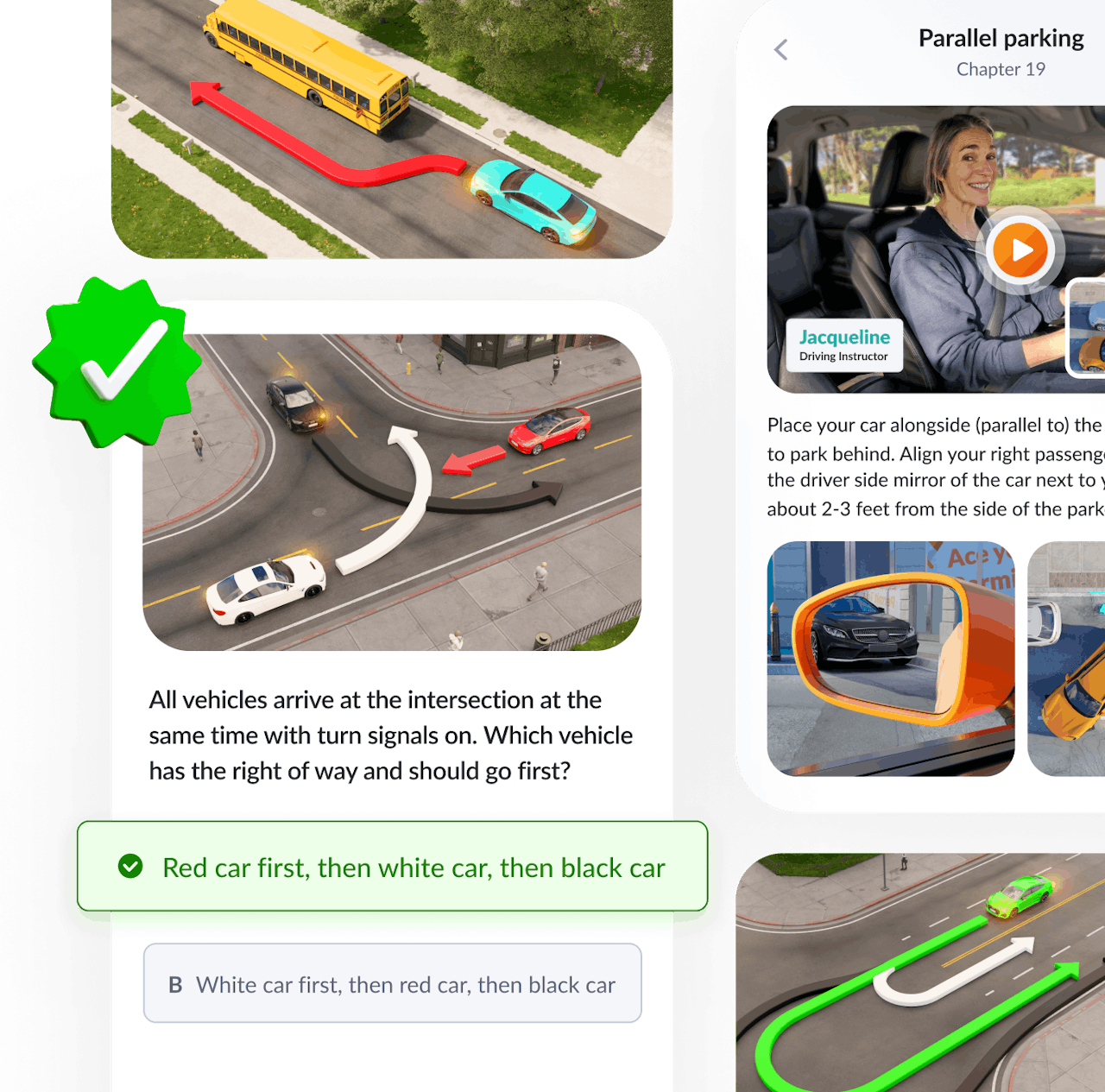
Take our full course with tests and theory
600+ exam-like questions and practice tests
Easy summarized DMV handbook
America’s #1 driver’s ed app with a 95.8% pass rate
Recommended articles

Ace your DMV test, guaranteed
Want to Be the Top School in Your Area?

- Simple & automated admin
- More time for teaching
- #1 learning materials for students
Start learning now
Resources
- Driver’s License Renewal
- How to Get Your US Driver’s License
- How to Prepare for Your Road Test
- How to Get a Driver’s Permit
- Behind-The-Wheel training
- Courses
- Blog
- FAQ
Show More


©2026 Zutobi AB, 4 Peddlers Row, Unit #103, Newark, DE 19702