loved by
15.1+ million
users
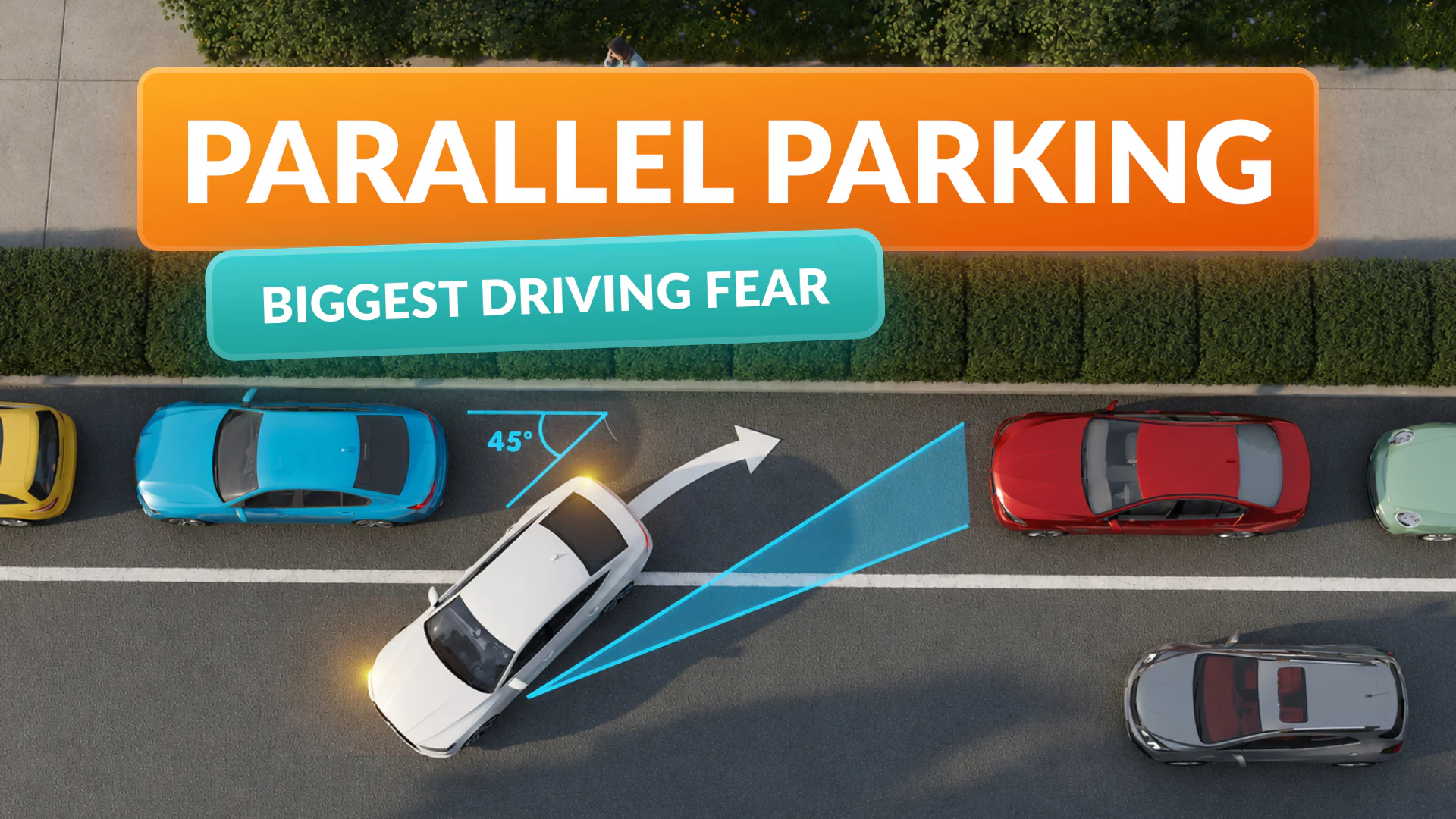
Parallel Parking Scares More Americans Than Failing the Driving Test. Here Is What the Data Actually Shows

Most people assume the driving test is stressful for one obvious reason: you might fail. But a new survey of 1,000 U.S. adults aged 18 to 54, commissioned by Zutobi, tells a different story.
The fears Americans carry into the driving test are more psychological than the failure-fear narrative suggests. And for them, the thing that scared them most was not failing at all, but a parking maneuver.
The Fears Americans Carry Into the Driving Test
Most people expect to feel nervous before their driving test. The data reveal how specific those nerves actually are. Only 14.2% of Americans said nothing scared them, a meaningful minority, but it is still a minority. The other 85.8% remember what their fears were.
The fears split into three distinct groups:
- The first is situational: 48.0% feared parallel parking, and 18.3% feared highway or high-speed driving.
- The second is performance anxiety: 42.7% feared failing and having to retake the test, the public, binary outcome that follows you out of the DMV.
- The third is psychological: 28.9% feared being watched and judged by the examiner, and 28.6% feared their own memory shutting down under pressure.
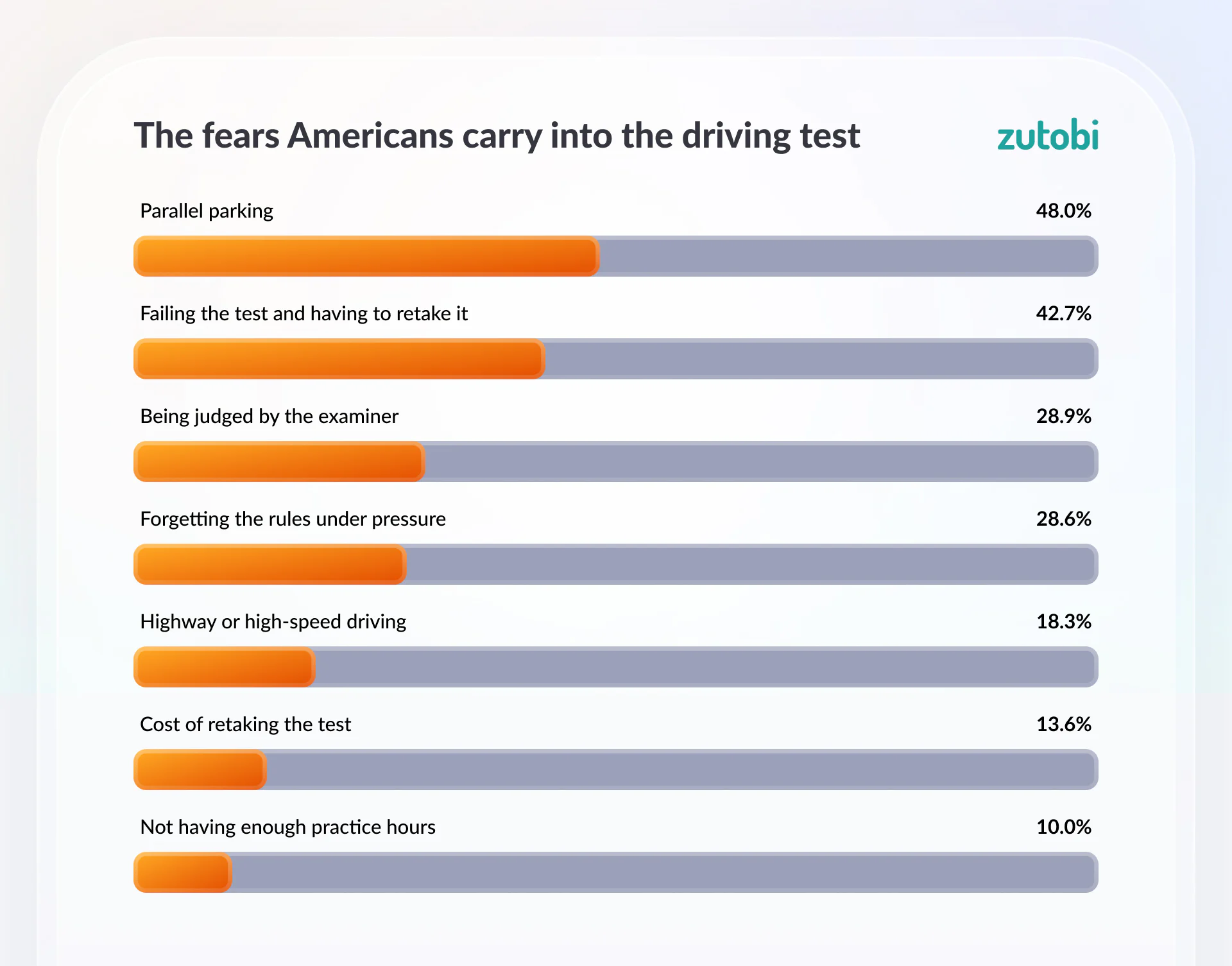
The Surprising Truth: Parallel Parking Is America’s Biggest Driving Test Fear
Failing the test is the fear most people would predict as number one, but it is not. By a
significant margin, the single most feared part of the driving test was parallel parking.
Nearly half of the respondents were more afraid of a parking maneuver than of the consequences of failing the test. Which means the American driving test is both a bureaucratic milestone and an emotional event. And for most people, the shape of that anxiety is very specific.
Parallel parking is unlike almost every other part of the driving test. It is performed at a complete stop, in full view of the examiner, with no moving variables to react to. There is nothing to blame but the driver. Such visibility and the sense of being watched while executing a slow maneuver may be what makes it so anxious. It is not necessarily the hardest skill on the test. But the data suggests it is the most emotionally loaded one.
Women Fear the Driving Test More, That Does Not Mean They Know It Less
| Parallel parking | Failing the test | Being judged | Forgetting rules | Highway driving | Cost of retake | Not enough practice | Nothing scared me | ||
| Women | 18–24 | 49.3% | 49.3% | 32.9% | 30.1% | 19.2% | 19.2% | 15.1% | 12.3% |
| 25–34 | 53.0% | 50.0% | 36.6% | 35.1% | 20.1% | 14.9% | 13.4% | 6.7% | |
| 35–44 | 53.0% | 41.0% | 30.1% | 29.5% | 16.3% | 12.0% | 9.0% | 8.4% | |
| 45–54 | 57.3% | 36.3% | 24.0% | 24.6% | 15.2% | 8.2% | 4.7% | 14.6% | |
| Men | 18–24 | 29.3% | 41.5% | 22.0% | 24.4% | 12.2% | 19.5% | 9.8% | 26.8% |
| 25–34 | 40.9% | 38.6% | 26.1% | 25.0% | 19.3% | 17.0% | 20.5% | 17.0% | |
| 35–44 | 45.1% | 44.5% | 31.9% | 31.3% | 23.6% | 12.6% | 8.2% | 17.0% | |
| 45–54 | 39.3% | 42.8% | 24.1% | 25.5% | 16.6% | 15.2% | 7.6% | 19.3% |
Across almost every fear category in this survey, women report higher rates than men. The parallel parking gap is the widest, 53.9% of women versus 41.0% of men, but it is not an outlier. Women aged 25 to 34 show the highest anxiety profile of any group: 50.0% feared failing, 36.6% feared being judged by the examiner, and 35.1% feared forgetting the rules under pressure. Across every age band, women consistently outnumber men in nearly every fear category.
As women age, their fear of failing the test and psychological fears like being judged decline gradually, but their parallel parking fear does not follow the same trajectory. Among women aged 45 to 54, parallel parking fear peaks at 57.3%, while “nothing scared me” rises to 14.6%.
The clearest single measure of this gap is the “nothing scared me” figure. 10.5% of women said nothing really scared them before their driving test, compared to 18.6% of men. Men were 1.78 times more likely than women to walk into the test feeling unbothered.
That gap is not explained by knowledge or skills. A 2018 UCLA study by Nancy Wayne and Gregory Miller, published in PLOS ONE, evaluated 100 novice drivers at a Los Angeles driving school and found that although female students rated their own confidence significantly lower than men, driving instructors gave both genders almost identical skill scores.
A 2006 Swedish study by Mats Wiberg, published in the Journal of Safety Research, found that among 11,862 theory test takers, a significantly larger proportion of women passed, and female test takers had overall higher scores than men. Higher anxiety does not reflect lower ability.
Nearly 3 in 10 Americans Feared Being Judged or Forgetting the Rules, Not the Road
Fear of being judged by the examiner (28.9%) and fear of forgetting the rules under pressure (28.6%) are separated by a single percentage point. They are effectively the same fear expressed two different ways: the fear of being watched, and the fear of falling apart while being watched.
The examiner is not a road hazard or a parallel parking space. They are a witness, and for nearly 3 in 10 Americans, that witness was the most frightening part of the experience. This matters because no amount of studying the rulebook addresses it. You can know every right-of-way scenario in the handbook and still freeze when someone is writing notes on a clipboard next to you.
How Zutobi Addresses the Fears This Data Identifies
Fear of parallel parking isn’t fixed by reading about it, just like examiner anxiety isn’t fixed by knowing the rules. Each fear in this data has a specific mechanism, and Zutobi addresses each one directly.
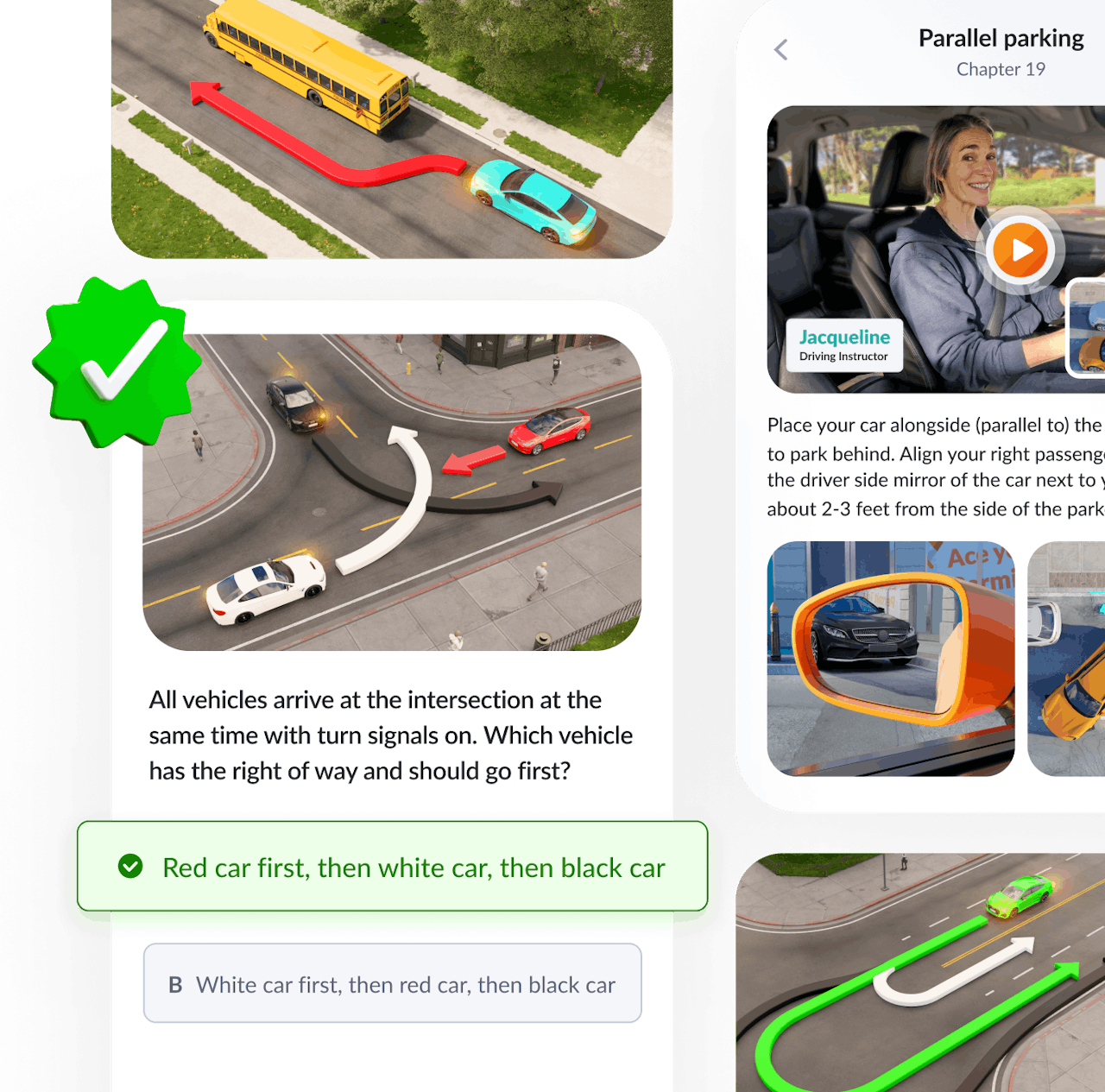
It is the only driver’s education app in the U.S. that covers the full journey from permit to road, teaching the entire handbook through video: short narrated lessons with visual demonstrations showing what each rule looks like on the road. Its exam simulator replicates your state’s exact DMV format, so the experience of being evaluated feels familiar before it is real. And for those still building confidence behind the wheel, Zutobi’s videos will help to extend preparation into the first miles.
85.8% of Americans walked into their driving test carrying at least one named fear. Most of them had no tool designed to address it. Zutobi is that tool.
FAQ
What do most Americans fear most about their driving test?
Parallel parking, according to a Zutobi survey of 1,000 U.S. adults aged 18 to 54 conducted in May 2026. 48.0% of respondents named it as their biggest fear when preparing for their driving test, ahead of failing the test itself (42.7%), highway driving (18.3%), and the cost of retaking the test (13.6%).
Is the fear of driving tests more common among women than men?
Yes, across nearly every fear category in the survey. Among women, 53.9% feared parallel parking before their test, compared to 41.0% of men. Men were 1.78 times more likely than women to say nothing scared them at all (18.6% vs. 10.5%). The survey measured self-reported fear during preparation, not on-road driving ability.
Does driving test anxiety fade with age and experience?
Not consistently. Among women aged 45 to 54, the oldest group in the survey with decades of driving experience, 57.3% still report that parallel parking scared them when preparing for their test. That is the highest rate of any age-and-gender group in the entire dataset, higher than women aged 18 to 24 (49.3%) and higher than men of any age.
Can fear of the driving test cause people to delay getting their license?
The data suggests a strong association. Among the 31.3% of respondents who said they delayed getting their license for fear-related reasons, fear of being judged by the examiner (44.4%) and fear of forgetting rules under pressure (44.4%) were each nearly twice as common as among those who got licensed without barriers (22.6% and 22.4%, respectively). Highway fear was three times as common in the fear-delay group.
How does Zutobi help learners deal with driving test anxiety?
Zutobi addresses the specific fears this data identifies. Its video-led handbook teaches every rule through narrated visual demonstrations, directly targeting the fear of forgetting under pressure. And its state-specific exam simulator replicates the exact DMV test format, so the experience of being evaluated feels familiar before the real test.
Methodology
All figures are from a Zutobi-commissioned survey conducted via Pollfish in May 2026 among 1,000 U.S. adults aged 18 to 54. The question on driving test fears is a multiple-selection question, so percentages can exceed 100%. Cross-tab figures reflect the share of each subgroup that selected each response. All age-based figures apply only to adults aged 18 to 54; there is no data for respondents aged 55 and over.
Take our full course with tests and theory
600+ exam-like questions and practice tests
Easy summarized DMV handbook
America’s #1 driver’s ed app with a 95.8% pass rate
Recommended articles

Ace your DMV test, guaranteed
Want to Be the Top School in Your Area?

- Simple & automated admin
- More time for teaching
- #1 learning materials for students
Start learning now
Resources
- Driver’s License Renewal
- How to Get Your US Driver’s License
- How to Prepare for Your Road Test
- How to Get a Driver’s Permit
- Behind-The-Wheel training
- Courses
- Blog
- FAQ
Show More


©2026 Zutobi AB, 4 Peddlers Row, Unit #103, Newark, DE 19702