loved by
15.1+ million
users
The 10 Hardest US Permit Test Questions in 2026, According to Data From 10 Million Drivers

Zutobi has been used by more than 10 million learners across all 50 states, and we ranked every question in our system by how often Americans got it wrong.
A “hardest” question is one that users got wrong the most often on their first try, before reviewing any explanations. Every question is drawn from official state DMV handbook material. We then ranked the full question pool and pulled the top 10.
The 10 Hardest US Permit Test Questions, Counting Down to #1
#10. Where must you stop when facing a STOP sign?
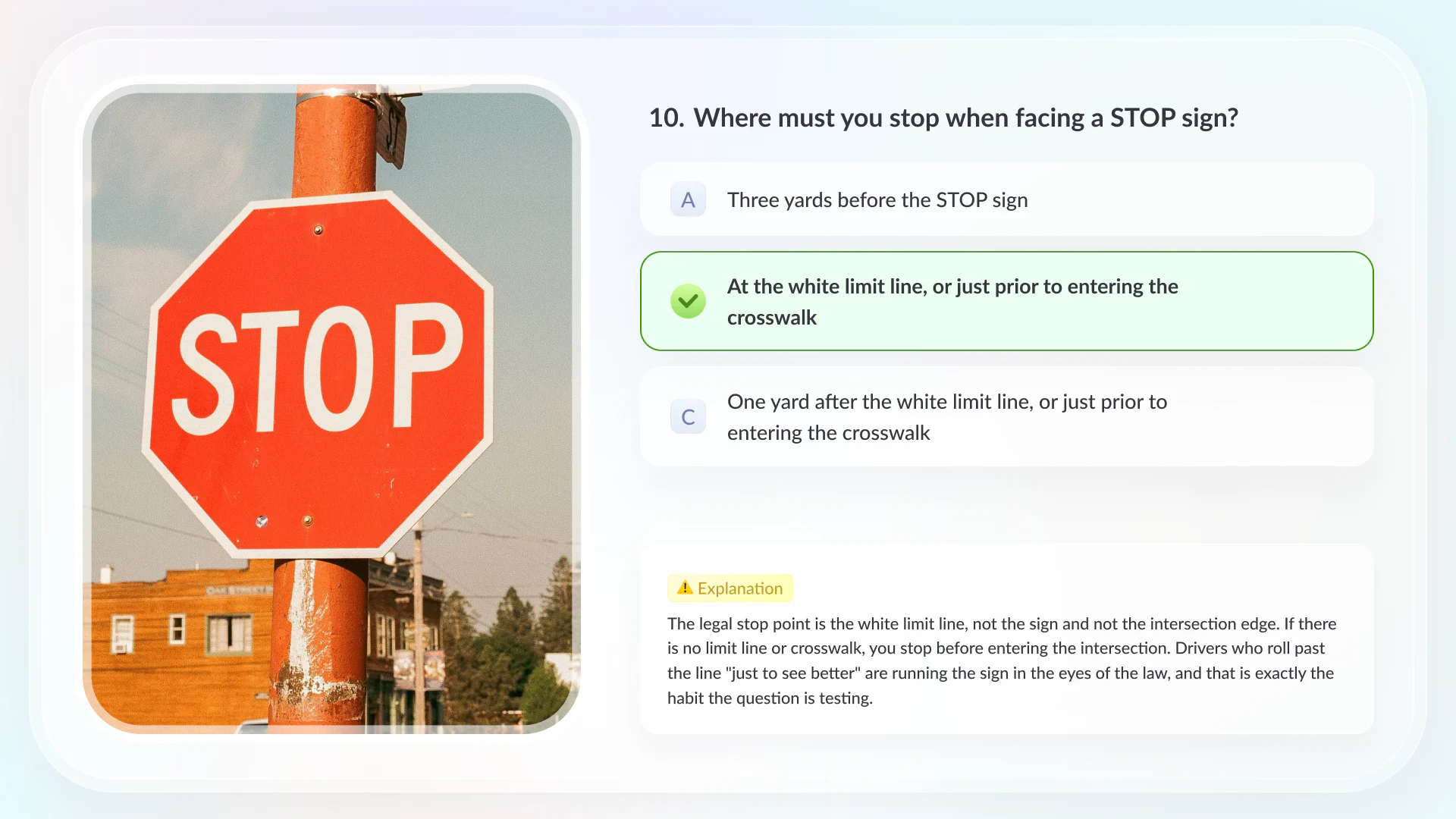
- A. Three yards before the STOP sign
- B. At the white limit line, or just prior to entering the crosswalk ✅
- C. One yard after the white limit line, or just prior to entering the crosswalk
The correct answer is B. The legal stop point is the white limit line, not the sign and not the intersection edge. If there is no limit line or crosswalk, you stop before entering the intersection. Drivers who roll past the line “just to see better” are running the sign in the eyes of the law, and that is exactly the habit the question is testing.
#9. Turning the steering wheel while stationary can damage what?
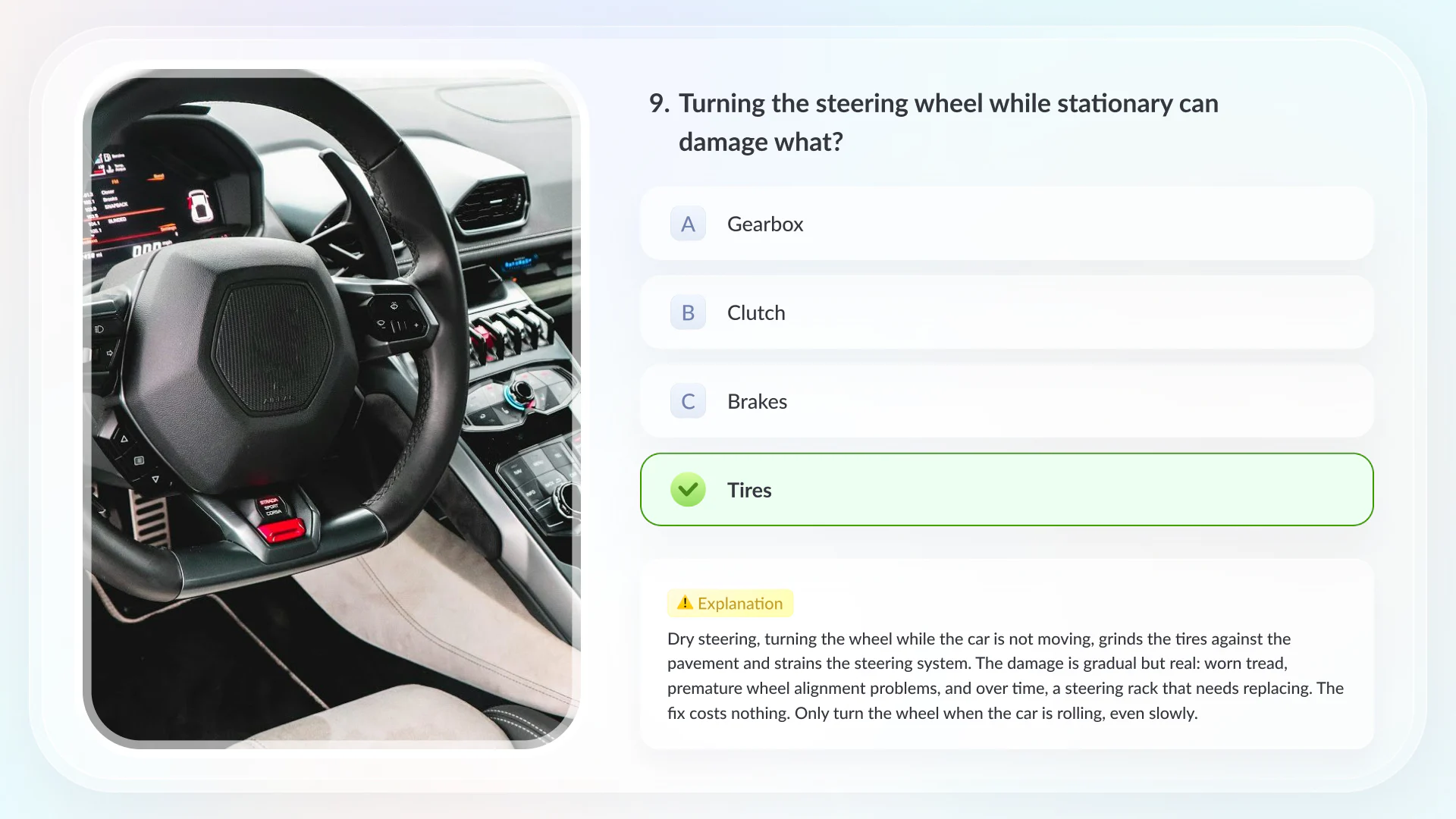
- A. Gearbox
- B. Clutch
- C. Brakes
- D. Tires ✅
The correct answer is D. Dry steering, turning the wheel while the car is not moving, grinds the tires against the pavement and strains the steering system. The damage is gradual but real: worn tread, premature wheel alignment problems, and over time, a steering rack that needs replacing. The fix costs nothing. Only turn the wheel when the car is rolling, even slowly.
#8. Before changing lanes on the freeway, signal for at least how long?
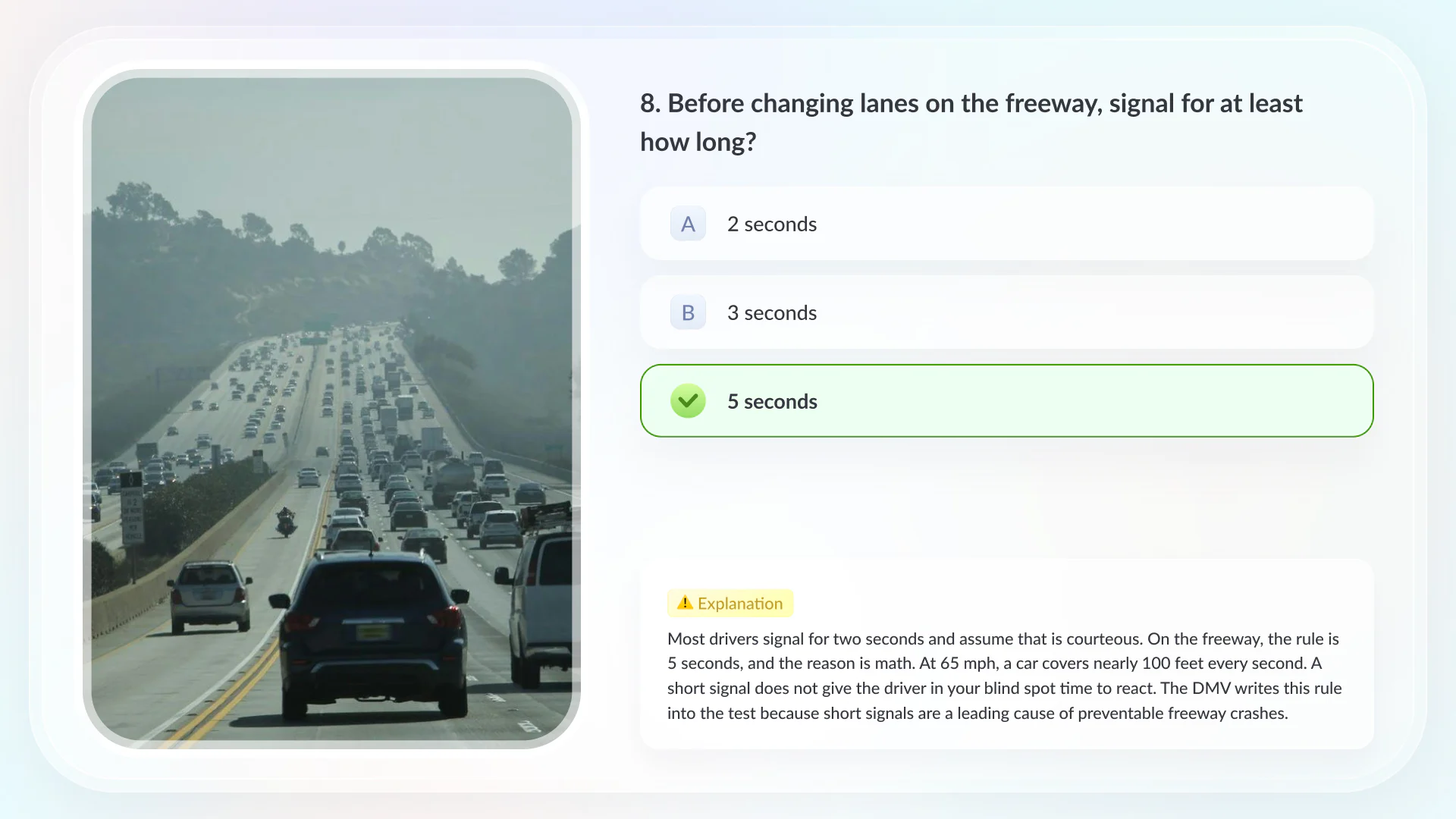
- A. 2 seconds
- B. 3 seconds
- C. 5 seconds ✅
The correct answer is C. Most drivers signal for two seconds and assume that is courteous. On the freeway, the rule is 5 seconds, and the reason is math. At 65 mph, a car covers nearly 100 feet every second. A short signal does not give the driver in your blind spot time to react. The DMV writes this rule into the test because short signals are a leading cause of preventable freeway crashes.
#7. What does “40” on a yellow curve sign actually mean?
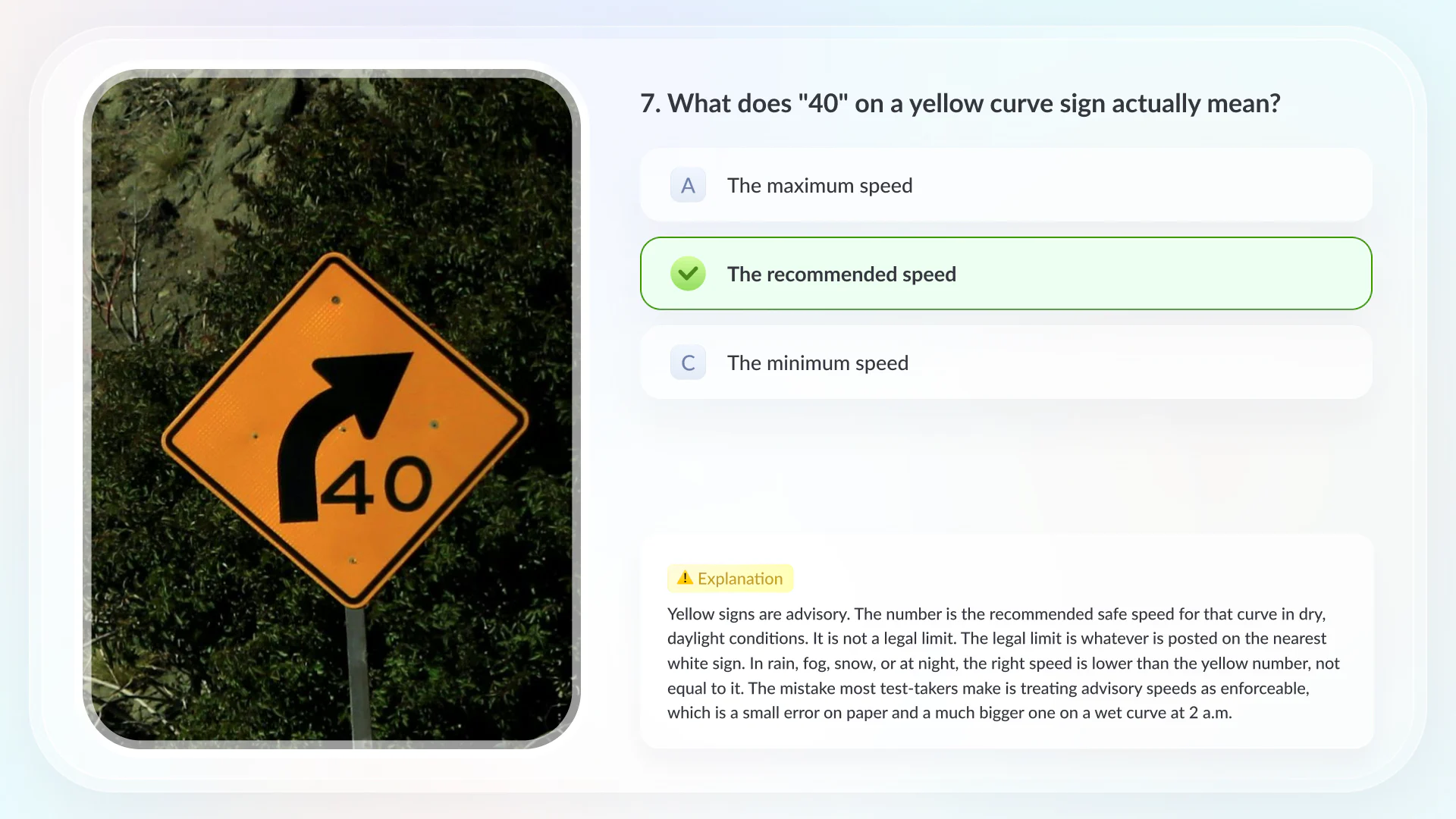
- A. The maximum speed
- B. The recommended speed ✅
- C. The minimum speed
The correct answer is B. Yellow signs are advisory. The number is the recommended safe speed for that curve in dry, daylight conditions. It is not a legal limit. The legal limit is whatever is posted on the nearest white sign. In rain, fog, snow, or at night, the right speed is lower than the yellow number, not equal to it. The mistake most test-takers make is treating advisory speeds as enforceable, which is a small error on paper and a much bigger one on a wet curve at 2 a.m.
#6. When a stopped school bus has its flashing red lights activated, who must stop?
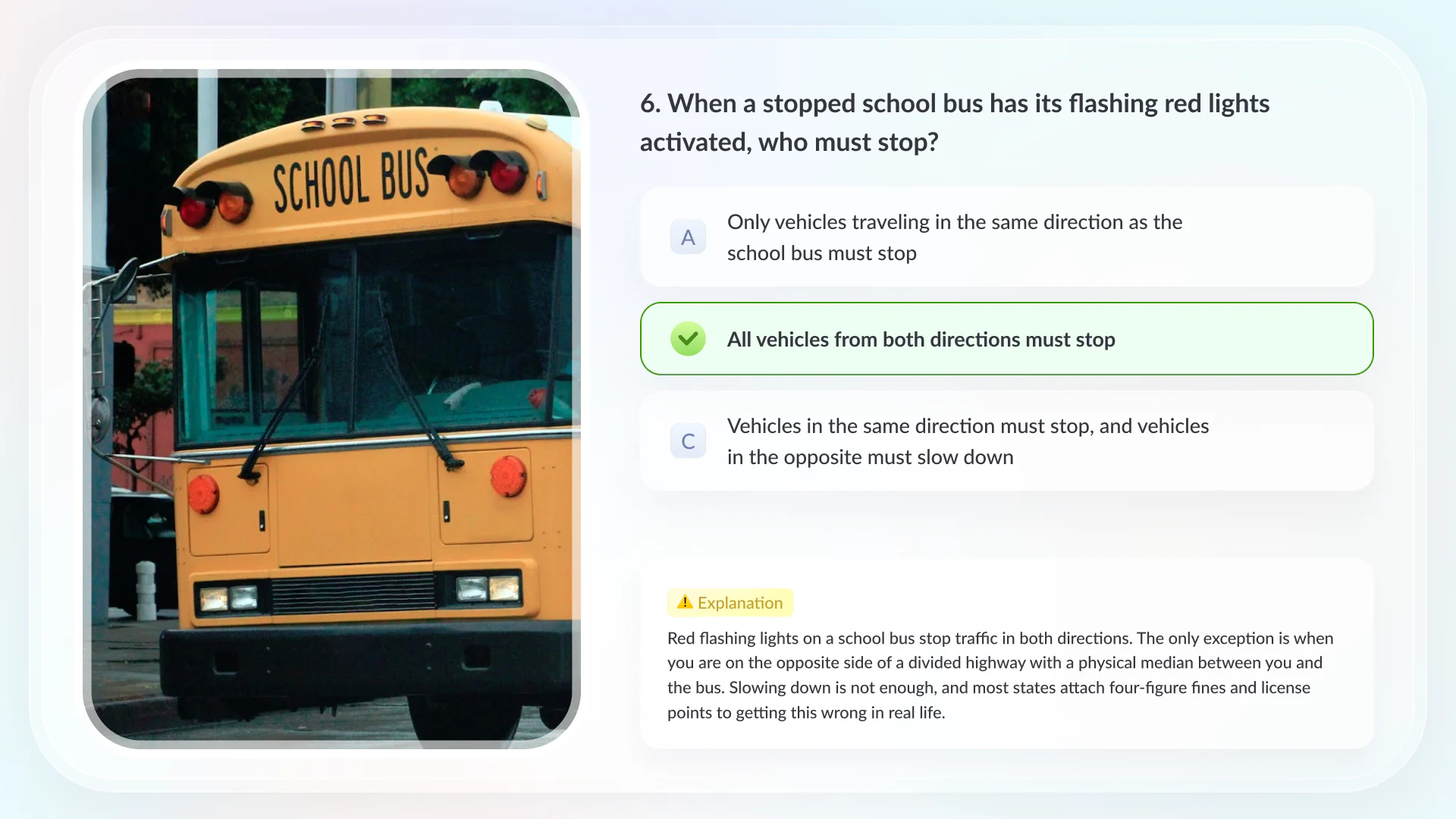
- A. Only vehicles traveling in the same direction as the school bus must stop
- B. All vehicles from both directions must stop ✅
- C. Vehicles in the same direction must stop, and vehicles in the opposite direction must slow down
The correct answer is B. Red flashing lights on a school bus stop traffic in both directions. The only exception is when you are on the opposite side of a divided highway with a physical median between you and the bus. Slowing down is not enough, and most states attach four-figure fines and license points to getting this wrong in real life.
#5. Are you allowed to cross double solid yellow lines to enter a driveway?
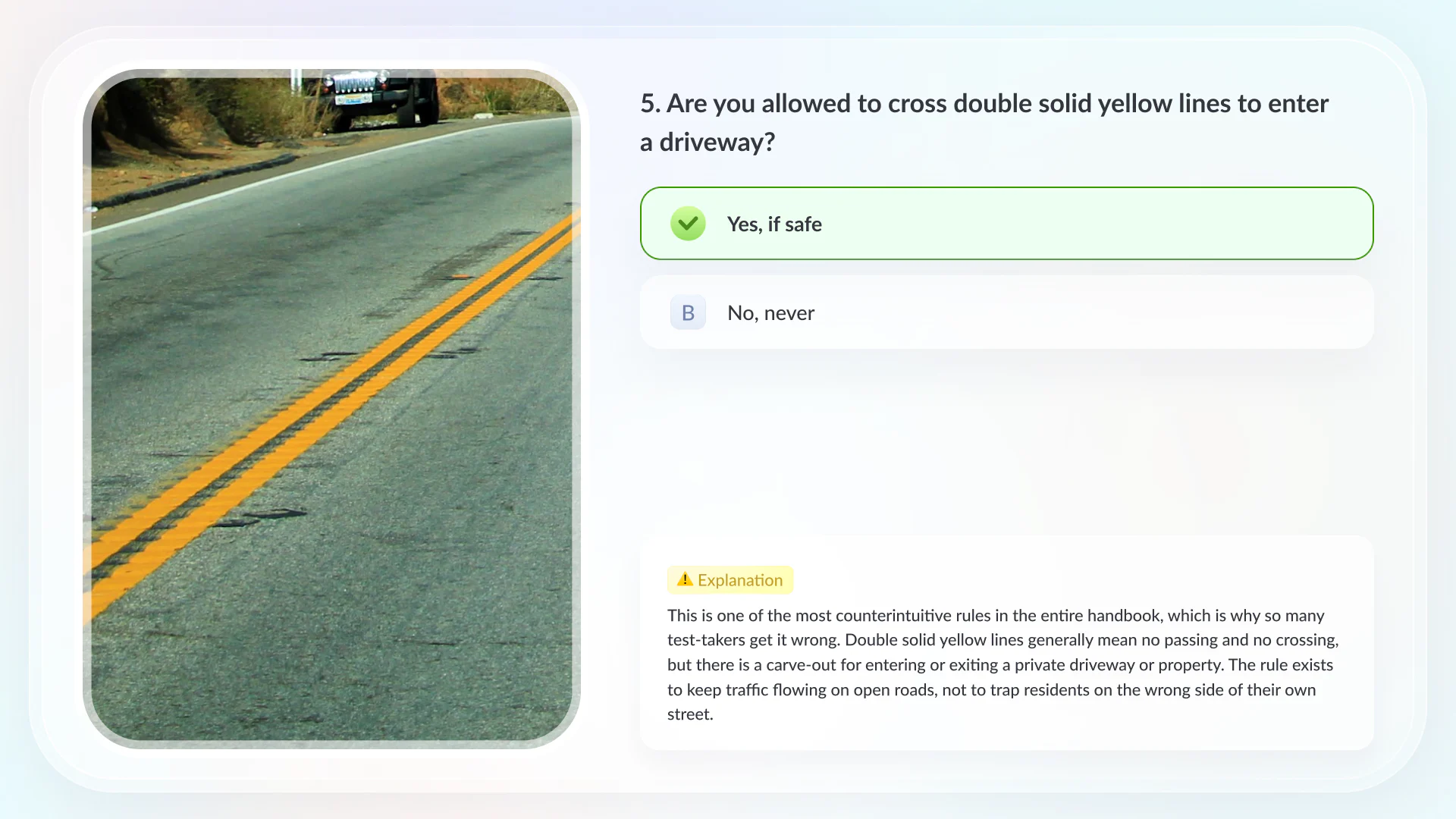
- A. Yes ✅
- B. No
The correct answer is A. This is one of the most counterintuitive rules in the entire handbook, which is why so many test-takers get it wrong. Double solid yellow lines generally mean no passing and no crossing, but there is a carve-out for entering or exiting a private driveway or property. The rule exists to keep traffic flowing on open roads, not to trap residents on the wrong side of their own street.
#4. You want to turn left at an intersection without STOP or YIELD signs. Which statement is true?
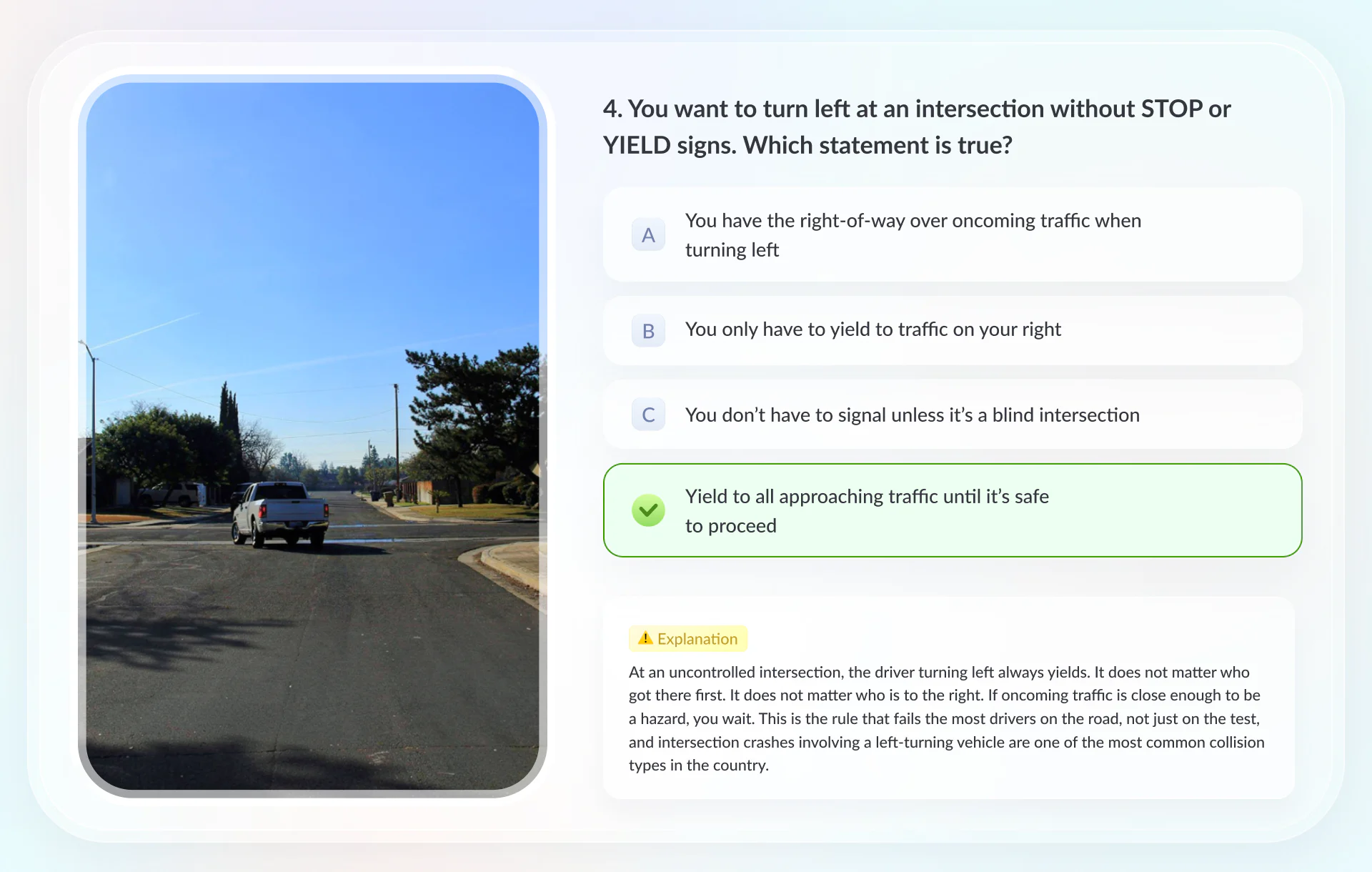
- A. You have the right-of-way over oncoming traffic when turning left
- B. You only have to yield to traffic on your right
- C. You don’t have to signal unless it’s a blind intersection
- D. Yield to all approaching traffic until it’s safe to proceed ✅
The correct answer is D. At an uncontrolled intersection, the driver turning left always yields. It does not matter who got there first. It does not matter who is to the right. If oncoming traffic is close enough to be a hazard, you wait. This is the rule that fails the most drivers on the road, not just on the test, and intersection crashes involving a left-turning vehicle are one of the most common collision types in the country.
#3. The red battery warning light is on. What does it mean?
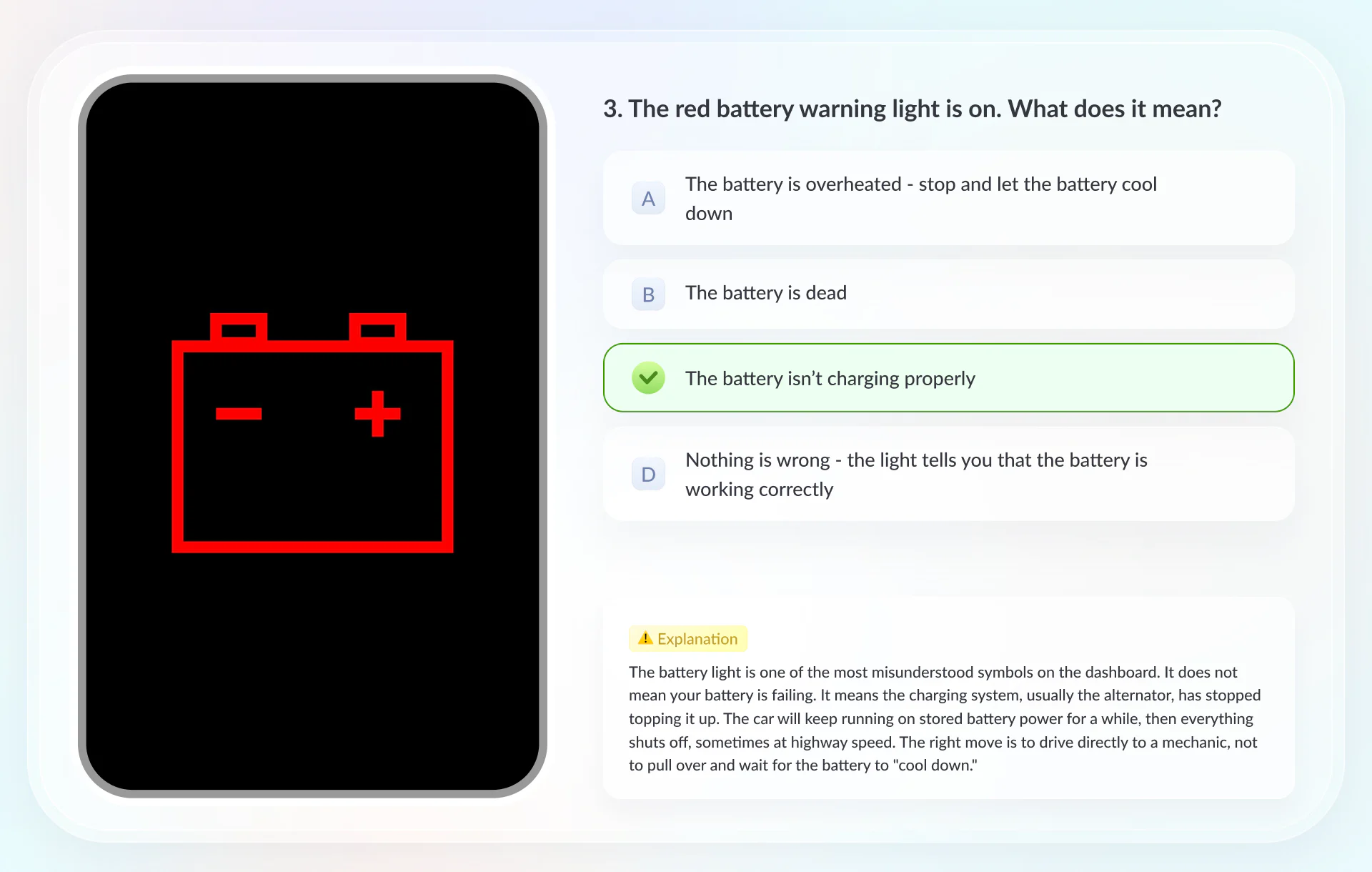
- A. The battery is overheated, stop and let the battery cool down
- B. The battery is dead
- C. The battery isn’t charging properly ✅
- D. Nothing is wrong, the light tells you that the battery is working correctly
The correct answer is C. The battery light is one of the most misunderstood symbols on the dashboard. It does not mean your battery is failing. It means the charging system, usually the alternator, has stopped topping it up. The car will keep running on stored battery power for a while, then everything shuts off, sometimes at highway speed. The right move is to drive directly to a mechanic, not to pull over and wait for the battery to “cool down.”
#2. Within how many feet of an emergency vehicle is it illegal to follow?
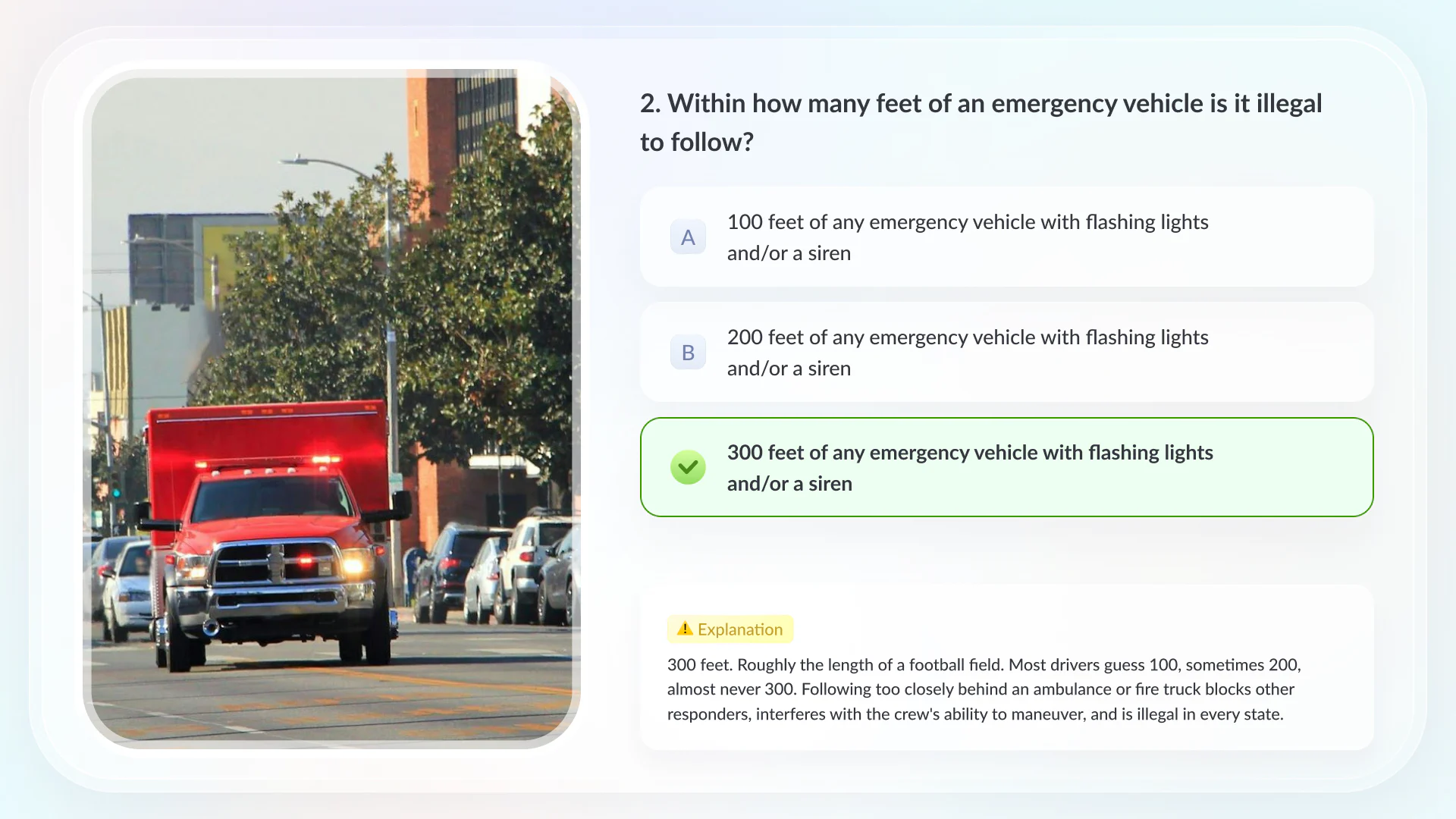
- A. 100 feet of any emergency vehicle with flashing lights and/or a siren
- B. 200 feet of any emergency vehicle with flashing lights and/or a siren
- C. 300 feet of any emergency vehicle with flashing lights and/or a siren ✅
The correct answer is C. 300 feet. Roughly the length of a football field. Most drivers guess 100, sometimes 200, almost never 300. Following too closely behind an ambulance or fire truck blocks other responders, interferes with the crew’s ability to maneuver, and is illegal in every state.
#1. Should you assume that other drivers will obey the road rules and yield when they are supposed to?
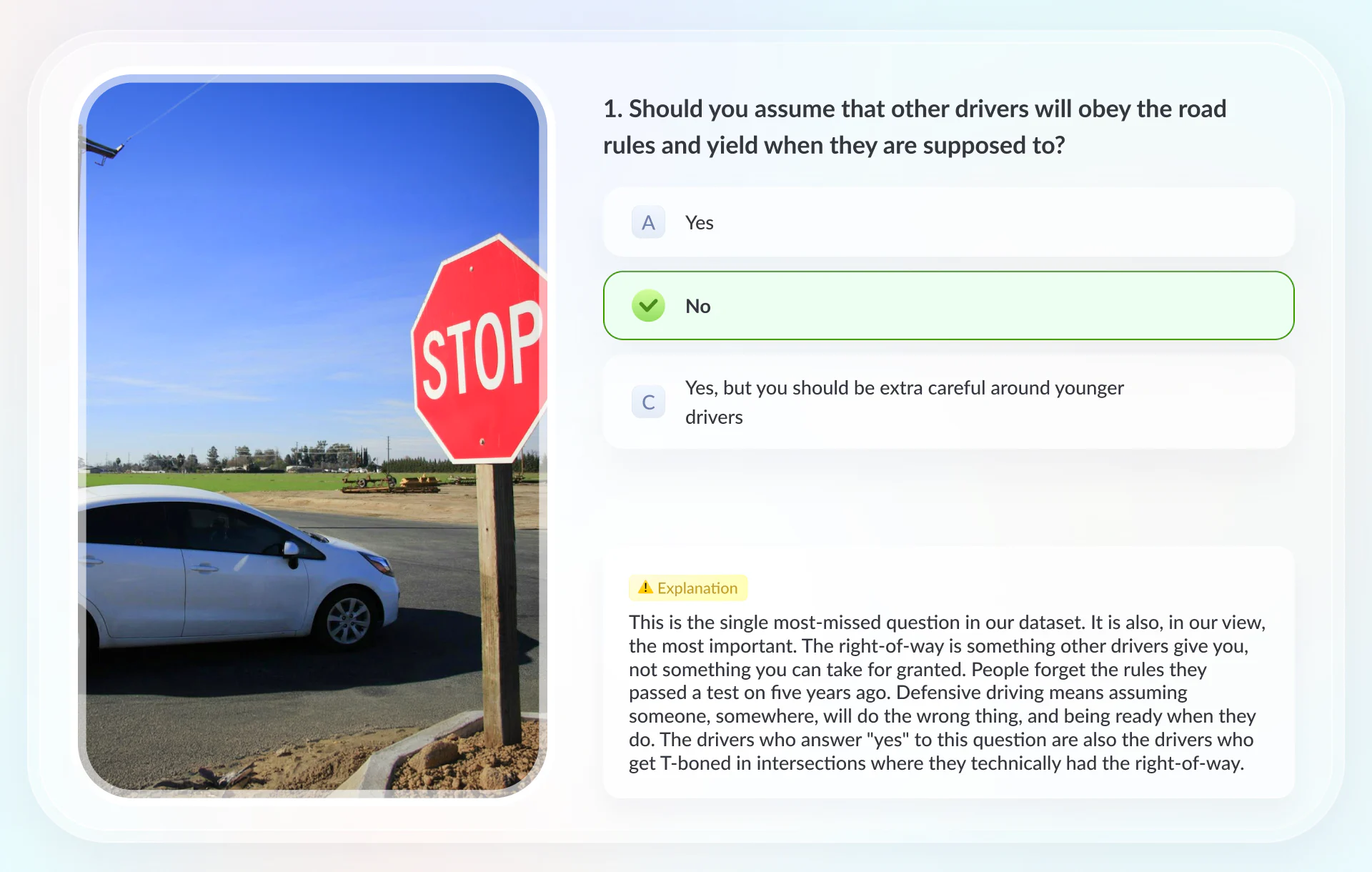
- A. Yes
- B. No ✅
- C. Yes, but you should be extra careful around younger drivers
The correct answer is B. This is the single most-missed question in our dataset. It is also, in our view, the most important. The right-of-way is something other drivers give you, not something you can take for granted. People forget the rules they passed a test on five years ago. Defensive driving means assuming someone, somewhere, will do the wrong thing, and being ready when they do. The drivers who answer “yes” to this question are also the drivers who get T-boned in intersections where they technically had the right-of-way.
What These Questions Reveal About American Drivers
Americans pass the permit test by memorizing signs and fail real driving by misjudging people. That is the thesis the top 10 keeps pointing back to, and it breaks down into four distinct patterns.
Pattern 1: Right-of-way is the single biggest weak spot
Of the hardest questions in our system, nearly half involve right-of-way, and almost all of those describe scenarios where the law is clear but human behavior is not:
- uncontrolled intersections
- left turns across oncoming traffic
- T-intersections
- multi-car situations where the right answer depends on what other drivers do next
These are the questions Americans fail, and these are the situations Americans crash in.
Pattern 2: Drivers memorize signs but miss the rules behind road markings
Drivers know yellow means caution and white means the same direction, but ask them when they are allowed to cross a specific line, and the certainty disappears. The double-yellow-into-a-driveway question is the cleanest example. The rule is just counterintuitive, and unless a learner reads the handbook carefully enough to find the exception, they default to “never cross a solid line” and get it wrong.
Pattern 3: Dashboard literacy has not kept pace with modern cars
The red battery warning question is failed at a higher rate than questions about engine braking, ABS, and tire maintenance combined. Cars have become more complex, the icons on the dash have multiplied, and driver education has not kept pace. New drivers can identify a stop sign in under a second and stare at a battery light for ten minutes, wondering if they should pull over.
Pattern 4: The defensive mindset is the hardest lesson of all
This pattern ties the other three together. The hardest question in the entire system is the one that asks whether you should trust other drivers. Millions of test-takers say yes. That answer is wrong on the test, and it is the same answer that gets people hurt on the road.
Why So Many Americans Fail the Permit Test on the First Try
- The handbook is built for reading, not for thinking. It describes rules in order. The test asks learners to apply them in scenarios that mix several rules at once.
- The hardest questions are scenarios, not facts. They ask the learner to picture an intersection, weigh what is legal against what is safe, and apply a rule that often has a counterintuitive exception.
- Skimming does not build recall. Reading a rule and answering a question about that rule uses different parts of memory. The drivers who pass on the first try are the ones who saw the question, got it wrong, and learned why.
- Most learners study the wrong material. They focus on signs and speed limits, which are the easiest questions on the test. The questions that fail people are about right-of-way and judgment.
How to Actually Prepare
The 10 questions above are the kind of material Zutobi is built around. Instead of asking learners to memorize a 100-page handbook, Zutobi breaks each state’s driver education content into short, gamified lessons with practice questions modeled on real DMV exams.
Zutobi is also the only provider in the US with a video-led handbook produced together with a certified driving instructor, so learners hear the rules explained the same way they would in a real driver’s ed classroom.
That is how the brain actually retains driving knowledge, and it is why more than 10 million people across all 50 states have used the app to prepare.
FAQ
What is the hardest question on the US permit test?
Based on first-attempt data from 10 million Zutobi users across the US, the hardest question is: “Should you assume that other drivers will obey the road rules and yield when they are supposed to?” The correct answer is no. More Americans get this question wrong than any other in the system, and it is missed more often than any question about signs, signals, or right-of-way rules.
Why do so many people fail the permit test?
Most Americans study the permit test by memorizing signs and speed limits, but the questions that actually fail people are about judgment: who yields at an uncontrolled intersection, when you can cross a solid line, and what to do when another driver does the wrong thing. Zutobi’s data shows that nearly half of the hardest questions involve right-of-way scenarios, and the single most-missed question is about whether to trust other drivers at all.
What is the easiest mistake to make on the US permit test?
Assuming that other drivers will follow the rules. In Zutobi’s data, the question “Should you assume that other drivers will obey the road rules and yield when they are supposed to?” is missed more often than any other question in the system. The correct answer is no. Defensive driving means assuming someone, somewhere, will do the wrong thing, and being ready for it.
What topics should I focus on when studying for the permit test?
Right-of-way and defensive driving. Of the hardest questions in Zutobi’s data, nearly half involve right-of-way scenarios: uncontrolled intersections, left turns across oncoming traffic, T-intersections, and multi-car situations where the right answer depends on what other drivers do next. Road markings and dashboard warning lights are the next two highest-error categories. Signs and speed limits, which most learners spend the most time on, are the easiest part of the test.
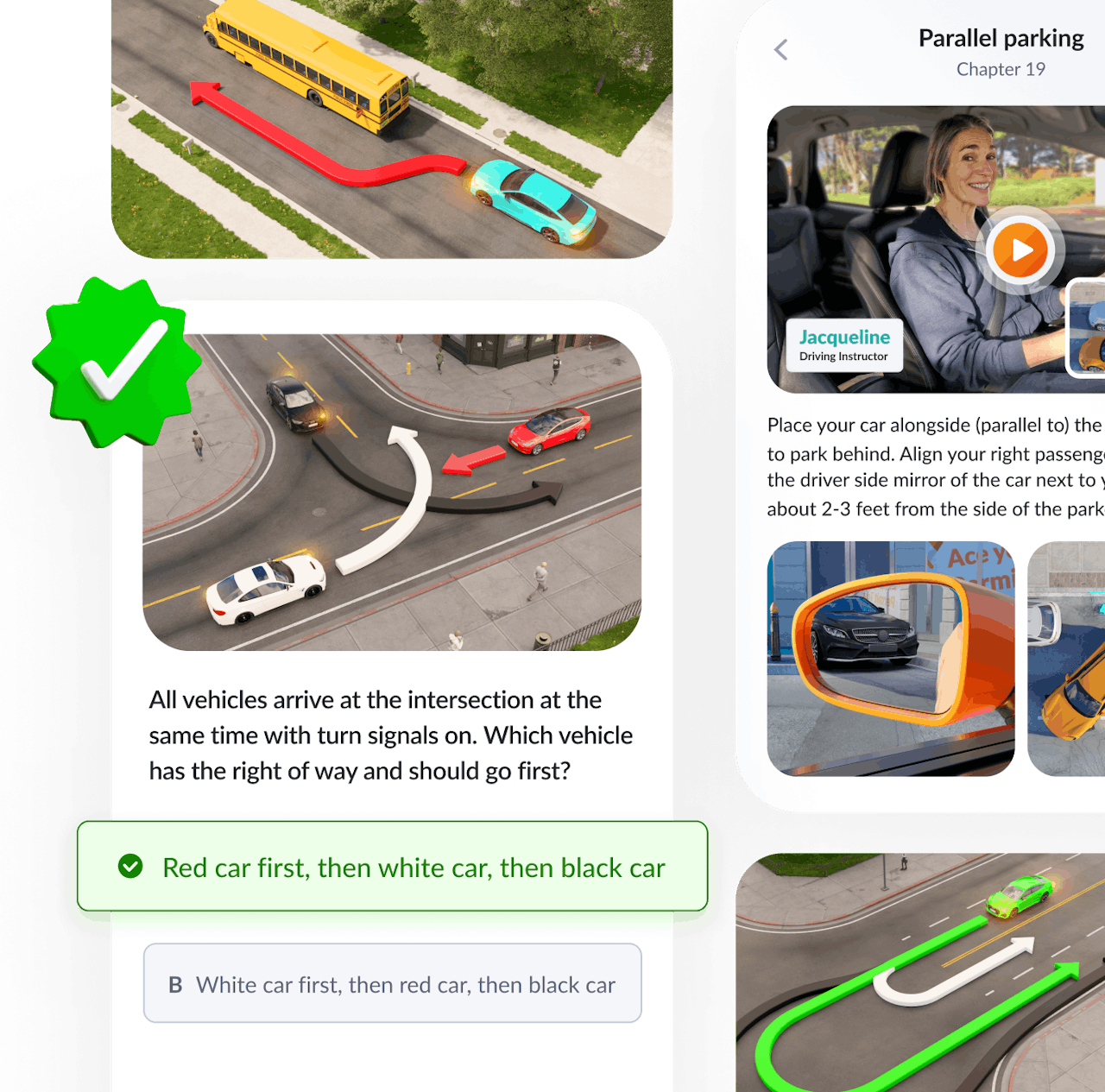
Take our full course with tests and theory
600+ exam-like questions and practice tests
Easy summarized DMV handbook
America’s #1 driver’s ed app with a 95.8% pass rate
Recommended articles

Ace your DMV test, guaranteed
Want to Be the Top School in Your Area?

- Simple & automated admin
- More time for teaching
- #1 learning materials for students
Start learning now
Resources
- Driver’s License Renewal
- How to Get Your US Driver’s License
- How to Prepare for Your Road Test
- How to Get a Driver’s Permit
- Behind-The-Wheel training
- Courses
- Blog
- FAQ
Show More


©2026 Zutobi AB, 4 Peddlers Row, Unit #103, Newark, DE 19702