CDL Testing in Texas: Pass Rates, the Hardest Stage, and What It Takes to Pass the First Time

Analysis of 102 months of Texas DPS Driver License Division data
Getting a commercial driver’s license is one of the most demanding licensing processes in the United States. Unlike a standard driver’s license, the CDL skills test is not one exam but a sequence of three separate stages, each with its own pass rate, its own pressure, and its own way of catching candidates off guard.
Most people assume the road test is the hardest part. It sounds like the obvious answer. It is the most visible part of the process, the one candidates tend to worry about most, and the one friends and family usually ask about first. But the data tells a different story.
Zutobi, an FMCSA-approved CDL theory provider, analyzed 102 months of Texas Department of Public Safety Driver License Division data, covering more than 850,000 CDL skills test attempts. The goal was to understand where candidates struggle most, how pass rates have changed over time, and what has shifted structurally in one of the country’s biggest CDL testing markets.
How CDL Testing Volume Has Changed Over Eight Years
Texas CDL testing changed significantly between 2017 and 2026. Two major trends shaped the data:
- the disruption caused by COVID-19 in 2020
- the rapid growth of third-party skills test providers (TPST)
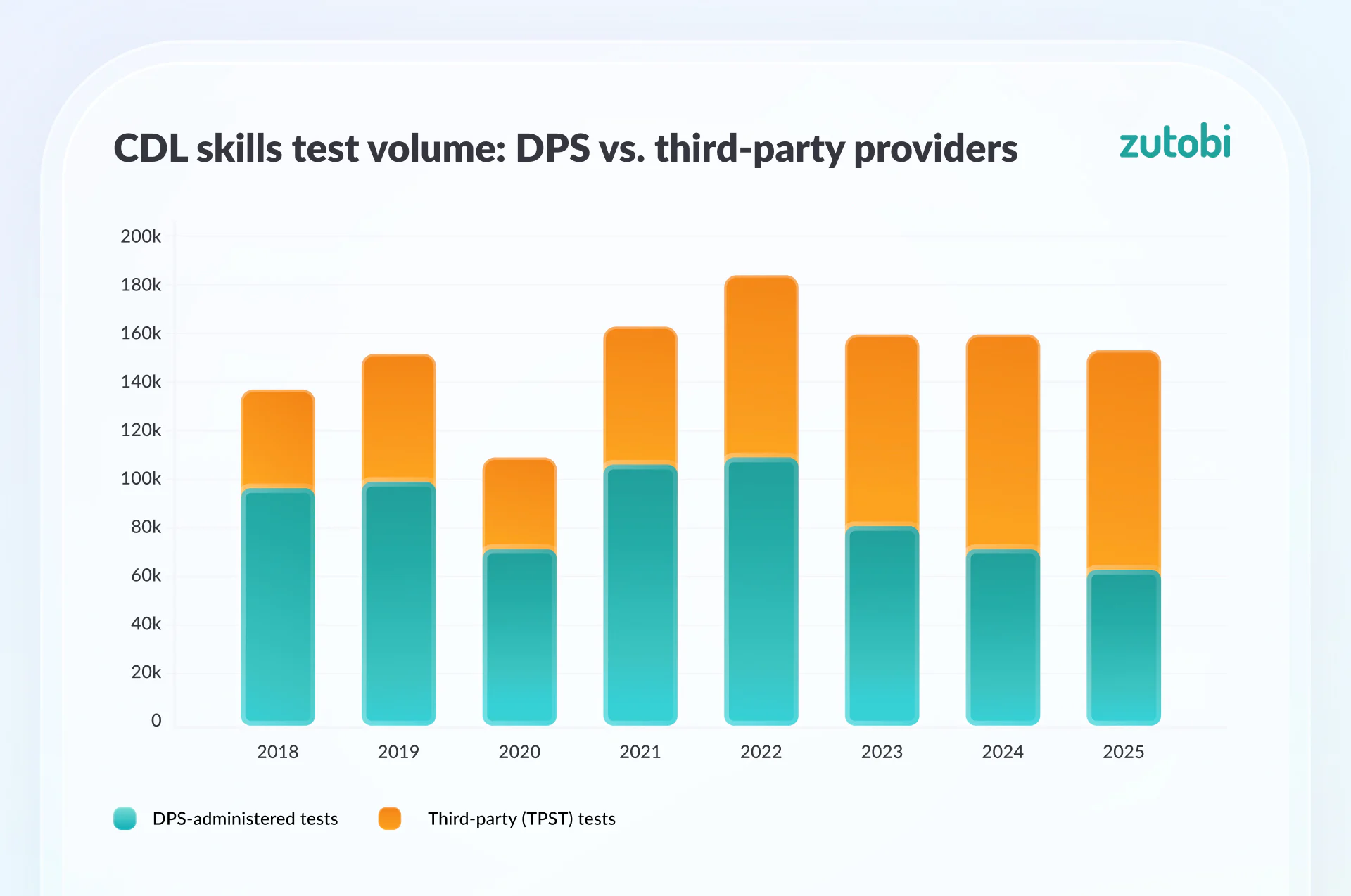
In late 2017, third-party providers handled only about 21% of all CDL skills tests. By 2019, that had grown to 35%. By 2023, third-party providers had caught up with DPS, and by 2025 they handled 59% of all tests.
The pandemic caused a sharp drop in testing volume in 2020, but when testing recovered, the rebound did not restore DPS to its earlier position. Most of the long-term growth was absorbed by private providers instead.
What changed most:
- 2017: DPS dominated CDL testing
- 2023: TPST and DPS volumes were roughly equal
- 2025: TPST became the clear majority channel
This is not just an administrative shift. It changes where candidates test, how quickly they get appointments, and what kind of training environment they face before the exam.
Which Stage Is Actually the Hardest?
The CDL skills test has three required stages:
- Vehicle inspection
- Basic control skills
- Road test
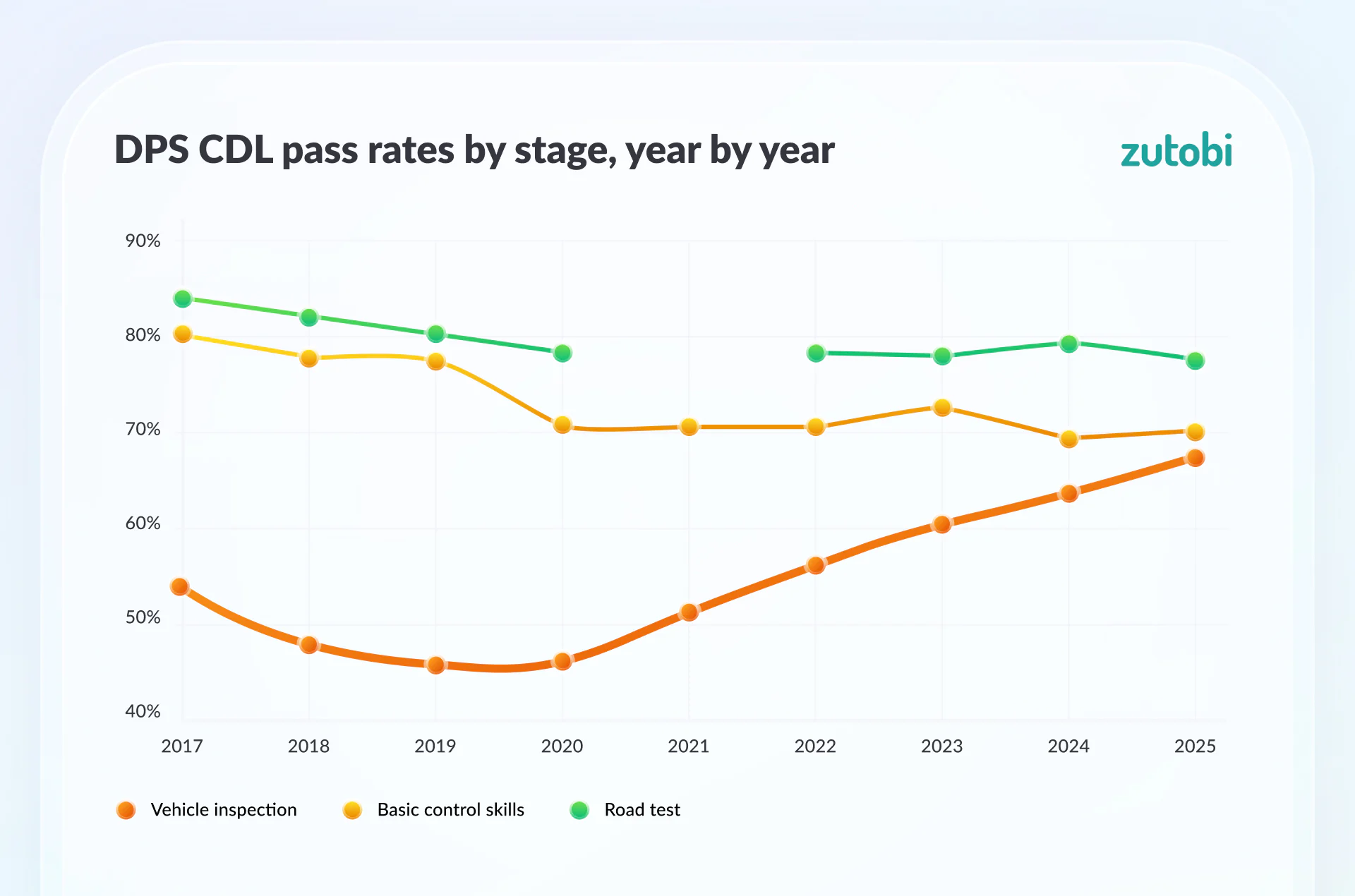
Most candidates focus on the road test. But across the Texas dataset, the vehicle inspection was consistently the lowest-performing stage.
DPS pass rates by stage, 2017–2025
- Vehicle inspection: from 45.9% to 67.4%
- Basic control skills: mostly 70–80%
- Road test: mostly 77–84%
Across all years analyzed:
- vehicle inspection remained the weakest stage
- basic control skills performed better
- road test pass rates stayed the highest
That makes the inspection stage the main bottleneck in the CDL process.
Why the inspection stage catches candidates off guard
The inspection is difficult not because candidates do not understand trucks, but because the test requires them to perform knowledge in a strict format.
Candidates must:
- follow the correct sequence
- identify and describe components out loud
- avoid missing even small checklist items
- do all of this while being scored in real time
A candidate can know the material and still fail because they have not practiced the structure of the test itself.
The Gap Between DPS and Third-Party Providers
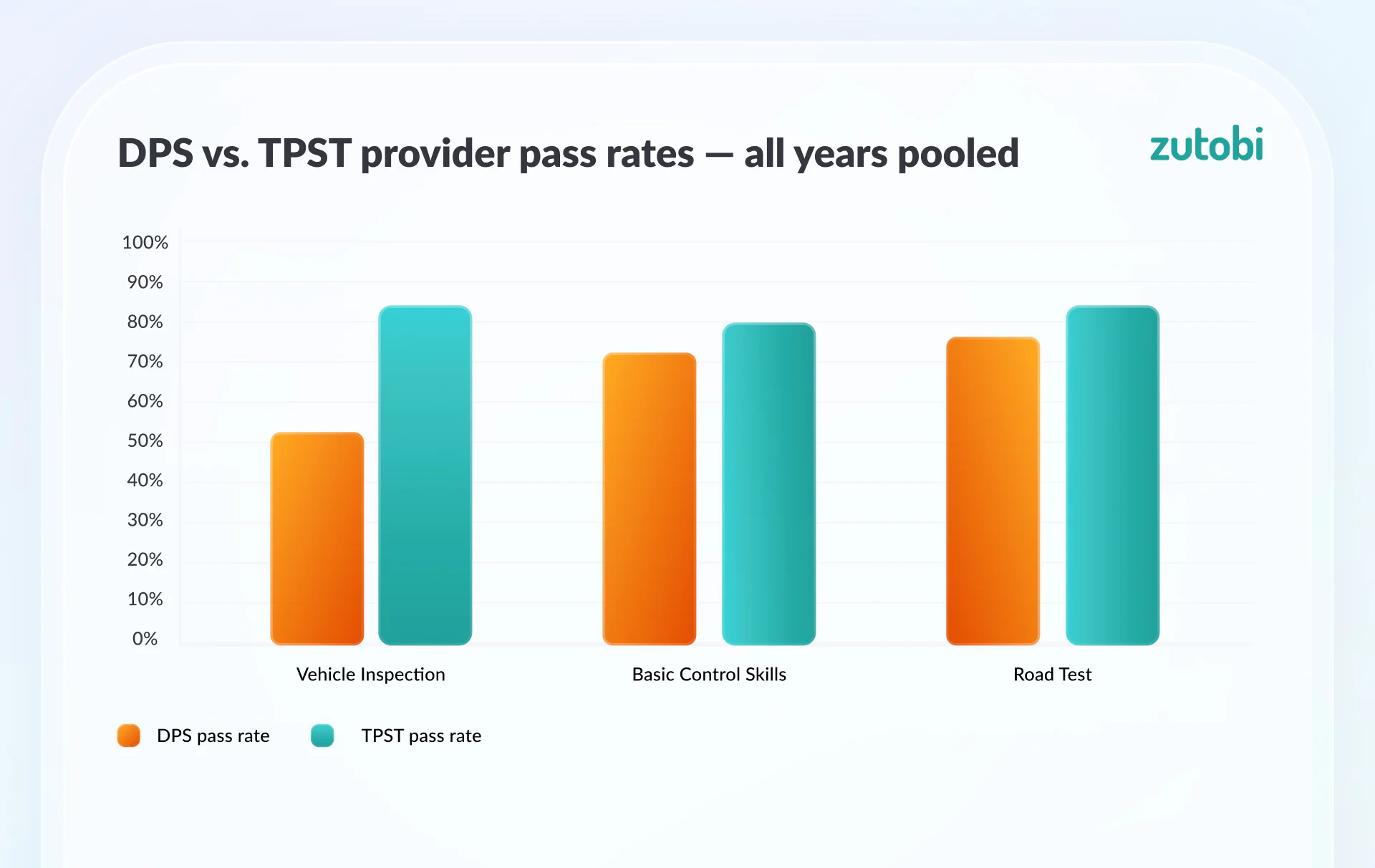
One of the most significant patterns in the data is the persistent, large gap in pass rates between DPS testing sites and third-party CDL skills test (TPST) providers. Across all years analyzed and all three stages, TPST pass rates are substantially higher than DPS rates.
Pooling all data from 2017 through early 2026:
- Vehicle inspection: DPS 53.5% vs. TPST 84.6% — a 31-point gap
- Basic control skills: DPS 73.0% vs. TPST 80.7% — an 8-point gap
- Road test: DPS 77.0% vs. TPST 84.9% — an 8-point gap
The vehicle inspection gap is the most striking. It is large enough that it almost certainly reflects more than examiner strictness differences alone. Candidate self-selection likely plays a role: drivers who choose to test at a private provider may be more prepared, or may have received hands-on training at that facility. Some TPST providers operate training programs alongside their testing function, which creates a pipeline of better-prepared candidates.
Whatever the mechanism, the practical implication is clear: candidates who arrive well-prepared, at a provider they’ve researched, do significantly better.
Third-party testing is now mainstream
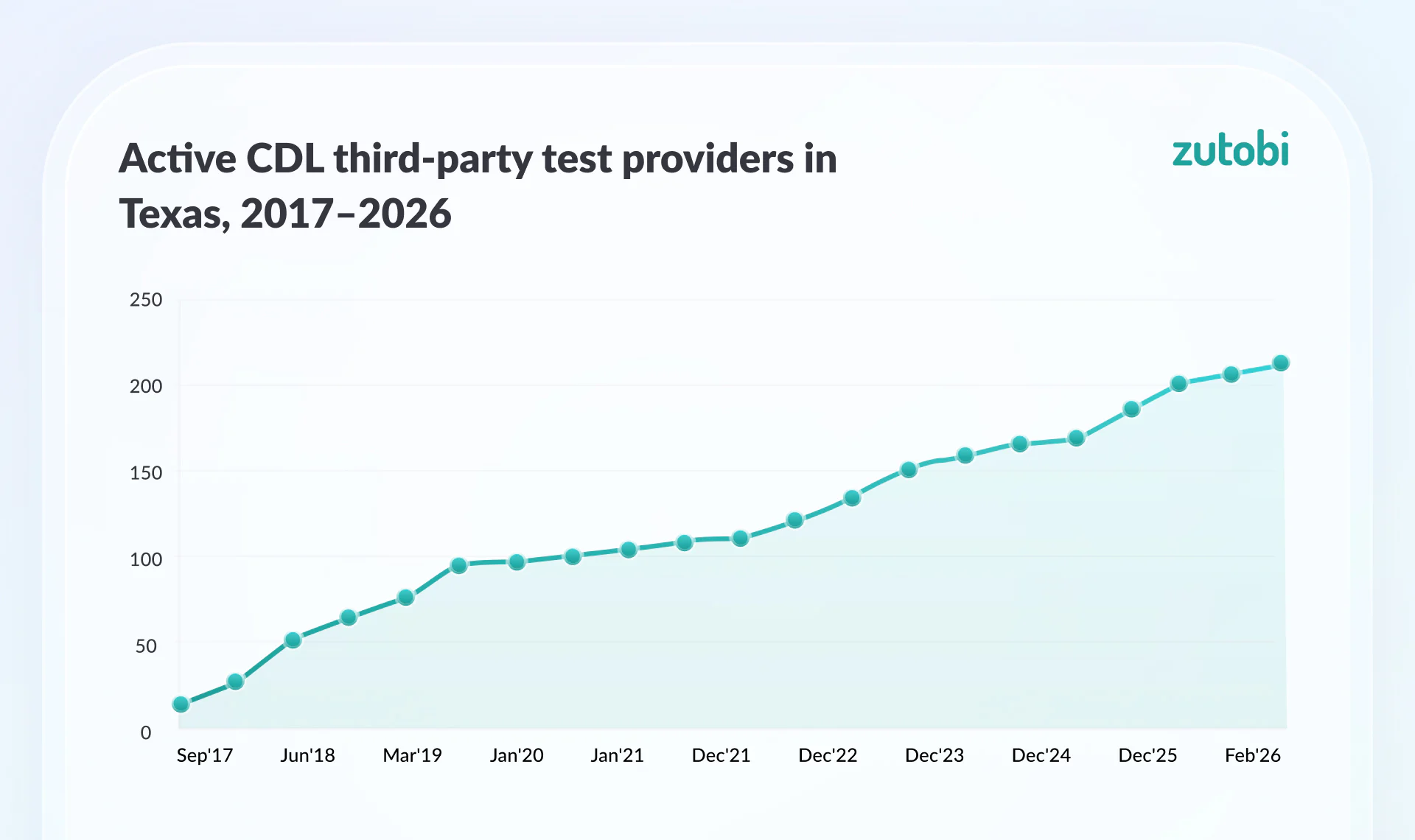
In September 2017, Texas had 15 approved third-party CDL skills test providers. By February 2026, there were 209. That’s a 14-fold increase in under nine years.
The growth was not linear. Providers grew steadily through 2018 and 2019 as the state expanded the program, then plateaued slightly during the pandemic years when testing of any kind contracted. Starting in 2022, growth accelerated sharply, the provider count went from around 110 at the start of 2022 to 168 by the end of 2024, and to 209 by February 2026.
The likely driver is the commercial driver shortage that followed COVID-19. The trucking industry faced significant pressure to license new drivers quickly, and expanding the testing network through private providers was one of the most direct levers available. Third-party providers can schedule tests faster, operate with more flexible hours, and often serve drivers at or near the facilities where they trained.
Is There a Better Time of Year to Take the CDL Test?
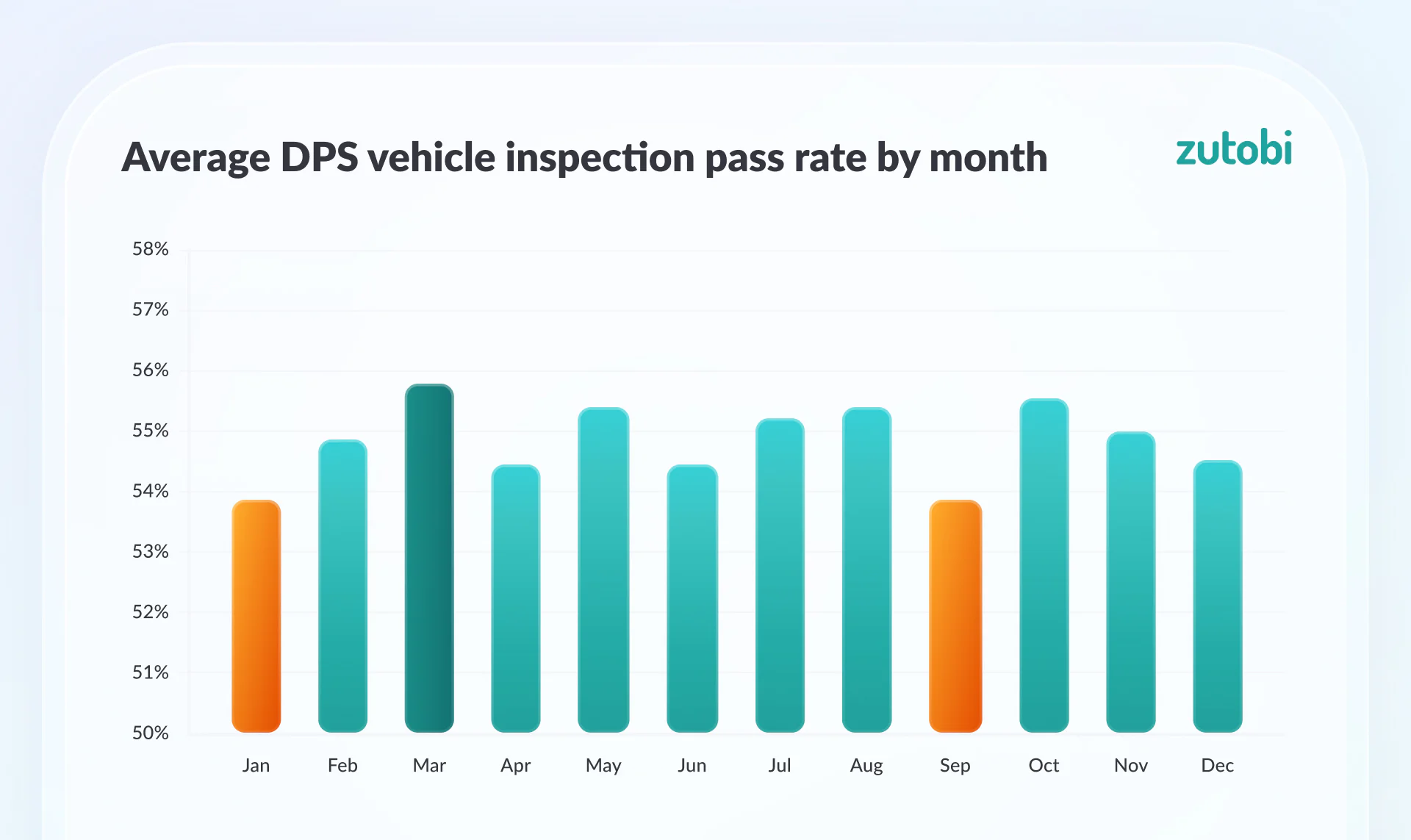
Test volume changes throughout the year, but pass rates do not change much.
Seasonal pattern
- busiest months: August, September, October
- quietest months: December, January
What does not change
The average DPS vehicle inspection pass rate stays in a very narrow band across the year, roughly between 53% and 56%.
That means there is no strong evidence for a “best month” to pass the test.
A quieter month may help with scheduling, but not with pass probability. Preparation remains the dominant factor.
What the data means for CDL candidates
Eight years of testing data points to a few consistent conclusions.
- The vehicle inspection is where most candidates lose.
It has been the lowest-performing stage throughout the dataset, and it remains challenging even as pass rates have improved. Candidates who spend their preparation time focused on general knowledge questions and driving practice, while giving the inspection checklist only cursory attention, are likely to fail the stage they least expected to fail.
- The format of the test matters as much as the knowledge.
The CDL exam, and particularly the inspection stage, requires candidates to demonstrate knowledge in a specific structured way: verbally, sequentially, in front of an examiner. Knowing the material and being able to perform it under test conditions are different skills. Practice tests that simulate the real exam format, not just the content, build both.
- Third-party providers are now the mainstream option.
With nearly 60% of Texas CDL skills tests now handled by TPST providers, candidates have real choices about where to test. Understanding your options, and arriving at a provider where you’re familiar with the environment and format, is a practical advantage.
- Endorsements require separate preparation.
The general knowledge test is the required starting point, but many CDL positions require one or more endorsements: air brakes, tanker, hazmat, combination vehicles, passenger, school bus, or doubles/triples. Each carries an 80% passing threshold. Treating endorsement study as a separate preparation track, rather than trying to absorb everything at once, significantly improves retention and pass rates.
How Zutobi Helps CDL Candidates Prepare
Zutobi is an FMCSA-approved CDL theory provider for all 50 states and Washington D.C.
The platform was built specifically to address the preparation gaps that the data identifies. Rather than presenting candidates with the full CDL handbook and asking them to absorb it cover-to-cover, Zutobi breaks the material into focused, manageable modules organized around the actual test structure. Each practice test uses questions that closely mirror the real exam format, with detailed explanations for every answer, so candidates understand not just what the correct answer is, but why.
Zutobi covers the general knowledge test and all CDL endorsement exams in a single course:
- General Knowledge
- Air Brakes
- Hazardous Materials
- Tanker Vehicles
- Combination Vehicles
- Passenger Vehicles
- School Bus
- Double and Triple Trailers
- Pre-Trip Inspection preparation
After completing any CDL module, Zutobi electronically notifies the TPR that the candidate is eligible to sit the corresponding test, removing an administrative step from the process.
The learning approach uses gamified progression, points, levels, and achievements, to keep candidates engaged across what can otherwise feel like a long and monotonous study process. The evidence on spaced repetition and active recall consistently shows that engagement matters for retention, particularly for procedural knowledge like the inspection sequence.
Methodology
This report is based on the Texas Department of Public Safety Driver License Division High Value Data Sets.
- Timeframe: September 2017 to February 2026
- Dataset: 102 monthly reports
- Scope: CDL skills tests across all three stages
- Coverage: DPS testing sites and third-party providers
Where clear reporting anomalies appeared, affected points were excluded from trend analysis. All other data was used as reported.

850+ exam-like questions
All you need to ace your endorsement tests
We are certified to issue Entry Level Driver Training (ELDT) certification to the TPR for CDL drivers.
Recommended articles

Ace your DMV test, guaranteed
Want to Be the Top School in Your Area?

- Simple & automated admin
- More time for teaching
- #1 learning materials for students
- Driver’s License Renewal
- How to Get Your US Driver’s License
- How to Prepare for Your Road Test
- How to Get a Driver’s Permit
- Behind-The-Wheel training
- Courses
- Blog
- FAQ
Show More


