loved by
15.1+ million
users

Why Micro-Learning Works in Driver’s Ed (It’s Learning Science, Not “Gamification”)

By Lucas Waldenback, Co-Founder of Zutobi
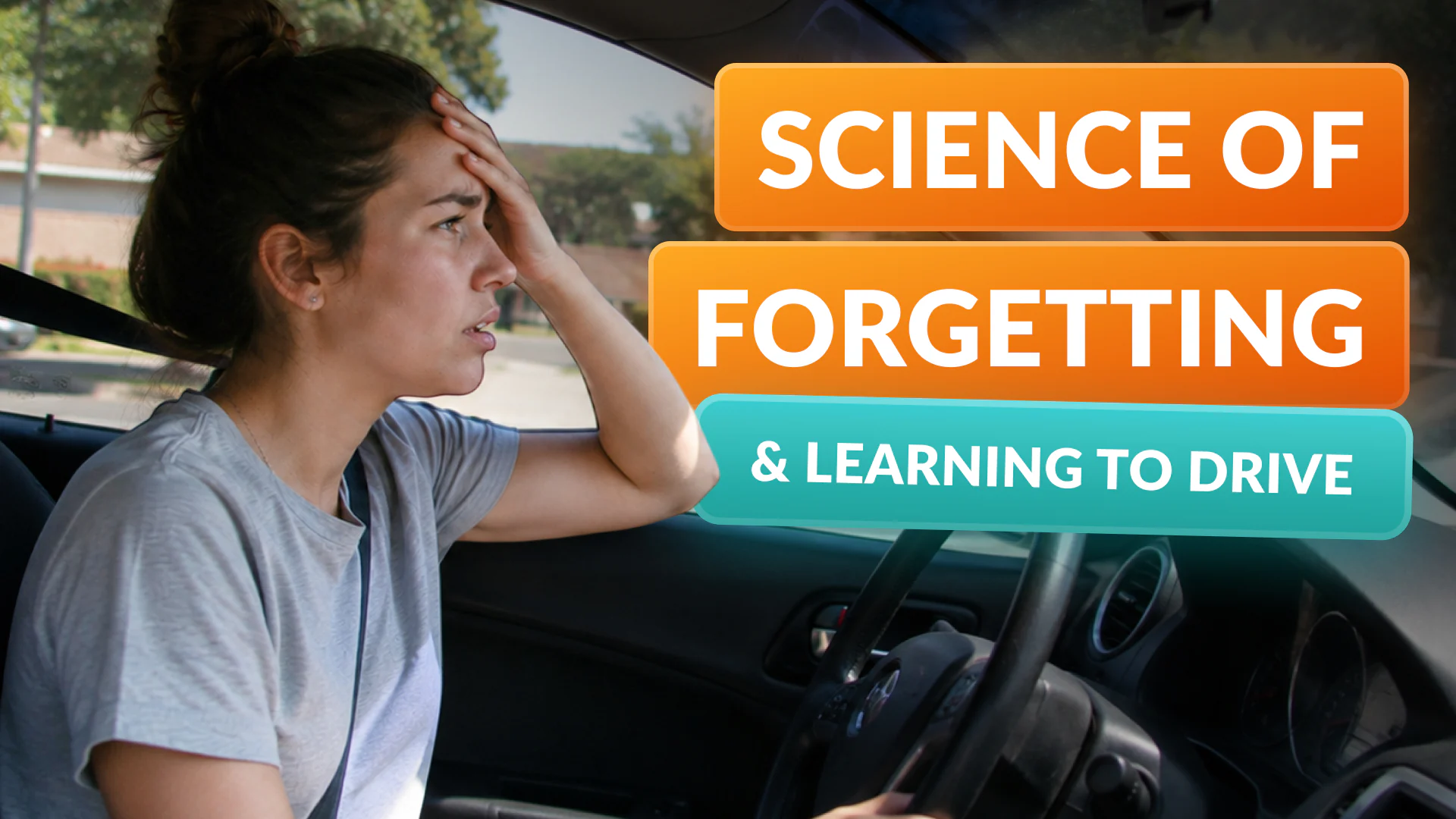
Here’s a fact that should change the way we think about driver’s education: people can forget up to 70% of newly learned information within 24 hours if nothing is done to reinforce it. Murre and Dros showed this in their 2015 research. That pattern tells us something important: learners can fail because memory decays fast without reinforcement.
This is especially relevant for driver’s ed, where the stakes couldn’t be higher. When someone freezes at an uncontrolled intersection or second-guesses a right-of-way rule at 45 miles per hour, the problem usually isn’t effort, it’s how the information was taught and practiced.
What many people call “gamification” in education is actually, at its core, evidence-based learning design. It’s built on principles cognitive scientists have studied for decades: retrieval practice, spaced repetition, immediate feedback, and manageable cognitive load. The game-like elements you see on the surface, such as points, levels, and progress tracking, are the delivery system. The learning science underneath is what actually works.
My argument is straightforward: micro-learning combined with structured practice and timely feedback is a better match for how the brain actually stores and retrieves the skills needed for safe driving. And the research backs that up.
What “gamification” really means in learning science (and why the label can be misleading)
The word “gamification” carries baggage. For many people, it suggests making something entertaining: adding rewards or animations to keep learners clicking. That framing misses the point. I’d like to define gamification more precisely: it’s a design structure that increases the frequency of practice, the quality of feedback, and the learner’s persistence over time. It is not about making studying “fun.” It’s about making studying effective.
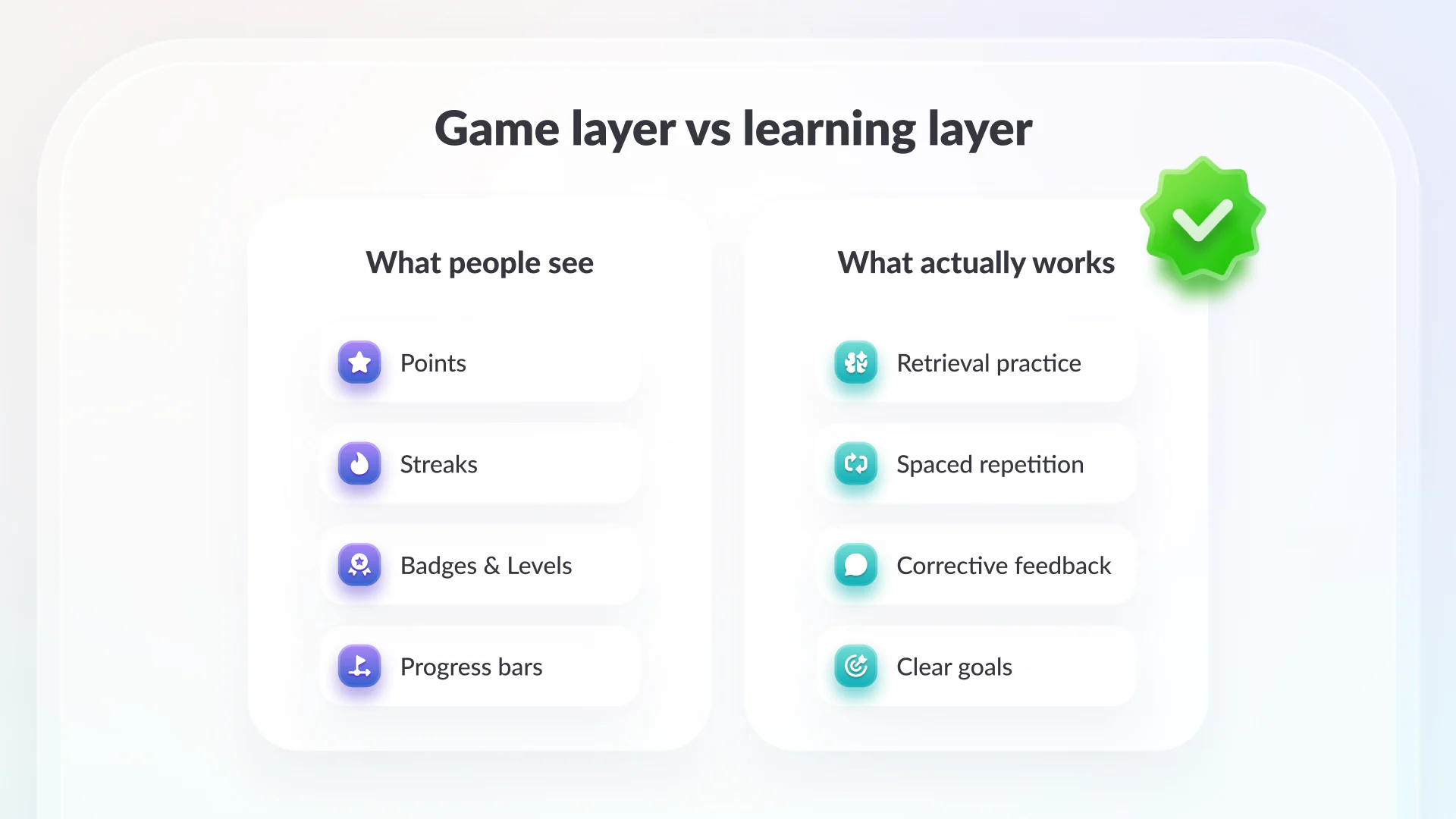
There’s an important distinction to draw here. On one side, you have game-like mechanics: things like points, streaks, levels, and badges. On the other side, you have learning mechanisms: retrieval practice (actively pulling information from memory), spacing (distributing study sessions over time), corrective feedback (knowing what you got wrong and why), and clear goals (understanding what you’re working toward). The first category is what people see. The second is what actually drives learning.
When done right, the game layer is simply the delivery vehicle for proven learning principles. In 2021, Latimier and colleagues published a meta-analysis in Educational Psychology Review examining studies that combined spaced and retrieval practice. They found that learners who used spaced retrieval outperformed roughly 84% of those who crammed the same material in a single session — a large effect by any standard.
Why micro-learning fits how memory actually works
Micro-learning is, at its simplest, the practice of breaking educational content into short, targeted modules, each focused on a single objective. A typical micro-learning session might last five to ten minutes and cover one concept, like who yields at a four-way stop, or how to read a shared-lane arrow marking.
Why does this format work? It reduces cognitive overload. The brain processes and retains information more effectively when it arrives in manageable portions rather than in large blocks. Short modules also support attention, learners stay engaged when they can see a clear start and finish, and they support consistency, because it’s easier to fit a five-minute session into a busy day than to carve out an hour.
This matters for driver’s ed in particular. The typical learner studying for a permit test is a teenager juggling school, extracurriculars, and maybe a part-time job. Or they’re an adult squeezing in study between work and family. In both cases, short lessons that can be completed on a phone during a break or before bed are more usable, which means they’re more likely to actually get done.
In 2023, Corbeil, Corbeil, and Khan, professors at the University of Texas Rio Grande Valley, published a study in Issues in Information Systems. They integrated micro-lessons into university coursework and measured the impact on knowledge acquisition and skill performance. The results were clear: students showed a statistically significant improvement on both knowledge and skills assessments after completing the microlearning modules. The researchers noted that the short, single-objective format allowed learners to process and apply new information more effectively.
In short, micro-learning matches how memory actually works.
Spacing beats cramming, especially for safety-critical knowledge
Most of us are familiar with the “study the night before” approach. It can work for passing a test tomorrow, but it’s a poor strategy for long-term retention. The distinction matters enormously when we’re talking about driving, because the knowledge you need at a blind intersection six months after your permit test has to still be there.
The spacing effect, the finding that distributing study over time produces better retention than concentrating it in a single session, is one of the most robust findings in all of learning science.
In 2025, Price and colleagues published a large-scale study in Academic Medicine that studied over 26,000 physicians and found a simple pattern: space it out, and people remember more.
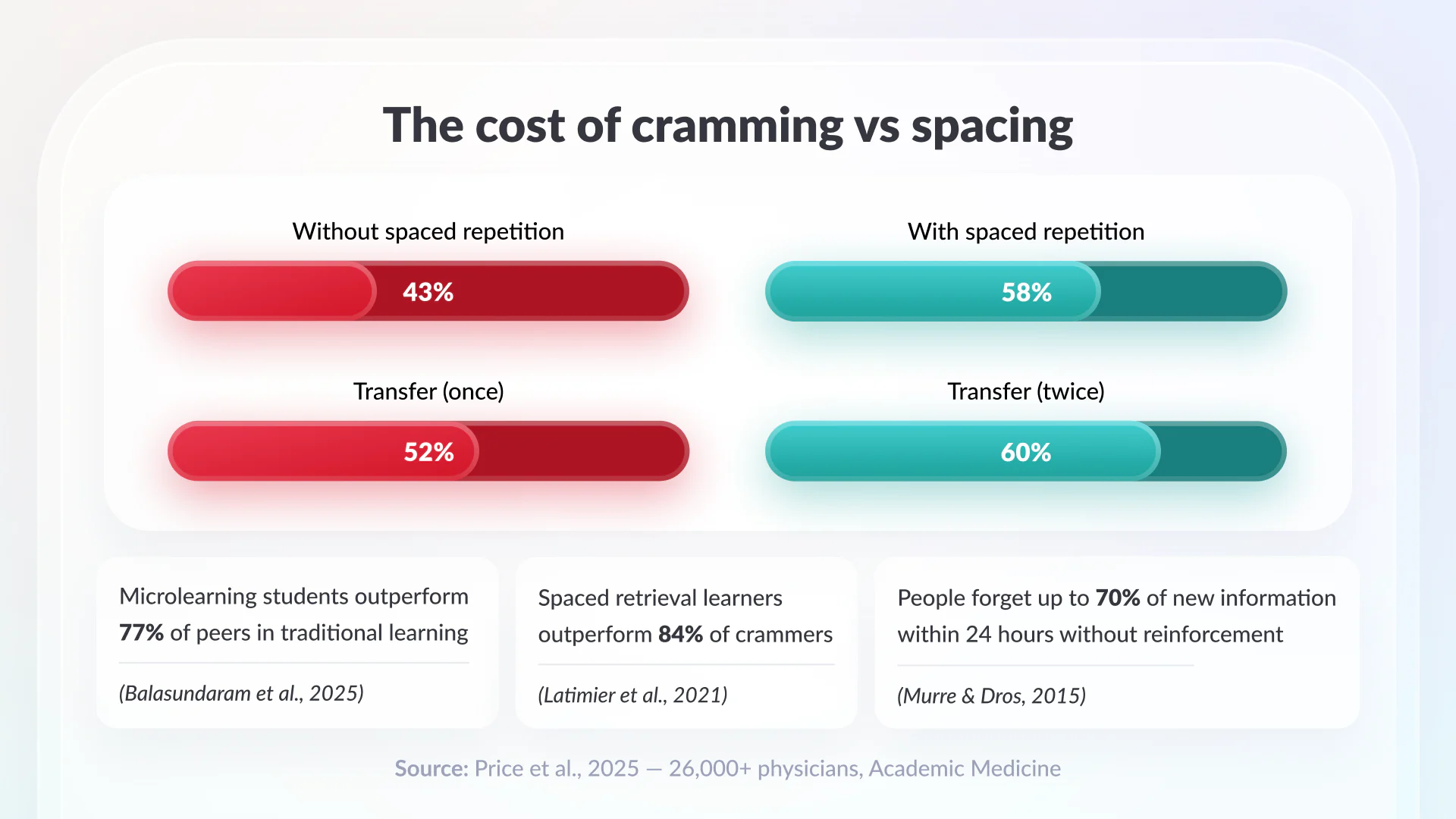
- Learning checks: the spaced-repetition group scored 58% vs. 43% without it.
- Applying knowledge in new situations: 58% vs. 52%.
- Doubling the repetitions made it even better: 62% vs. 52% for learning, and 60% vs. 56% for transfer.
To make it concrete: five to ten minutes of focused study per day over two weeks will almost always produce better long-term retention than one marathon session the night before the test. The first approach spaces out the retrieval attempts, giving the brain time to consolidate each piece. The second gives the illusion of preparedness that fades fast.
For safety-critical knowledge, where the consequences of forgetting are not a lower grade but a potential collision, spacing isn’t a nice-to-have. It’s essential.
Why feedback matters more than badges, and why the stakes are life or death
Points and badges only help if they’re connected to meaningful feedback that shows you why a road sign means what it means or why the right-of-way rule works the way it does. Good systems track where each learner is strong and where they’re weak. A learner who keeps missing hazard perception questions sees more of those, spaced intelligently. A learner who has mastered sign recognition moves on.
At Zutobi, we publish an annual Teen Road Fatalities Report analyzing data from the National Highway Traffic Safety Administration (NHTSA), and the numbers are sobering. In 2023:
- 3,262 people were killed in crashes involving teen drivers aged 15 to 20, a 5.8% increase from the year before and 31.4% higher than in 2019, pre-pandemic.
- Speeding was the leading factor, contributing to 1,984 deaths.
- Alcohol-related crashes claimed 687 lives.
- Distracted driving killed 348 teens, up 17.6% in a single year.
These numbers represent knowledge gaps that turned into split-second mistakes on the road. Driver’s education is safety education, and the knowledge a new driver acquires needs to be accessible not just on test day but six months later, at an unfamiliar intersection, under pressure. That’s a recall problem, and it’s exactly the problem that well-designed feedback loops, retrieval practice, and spaced repetition are built to solve.
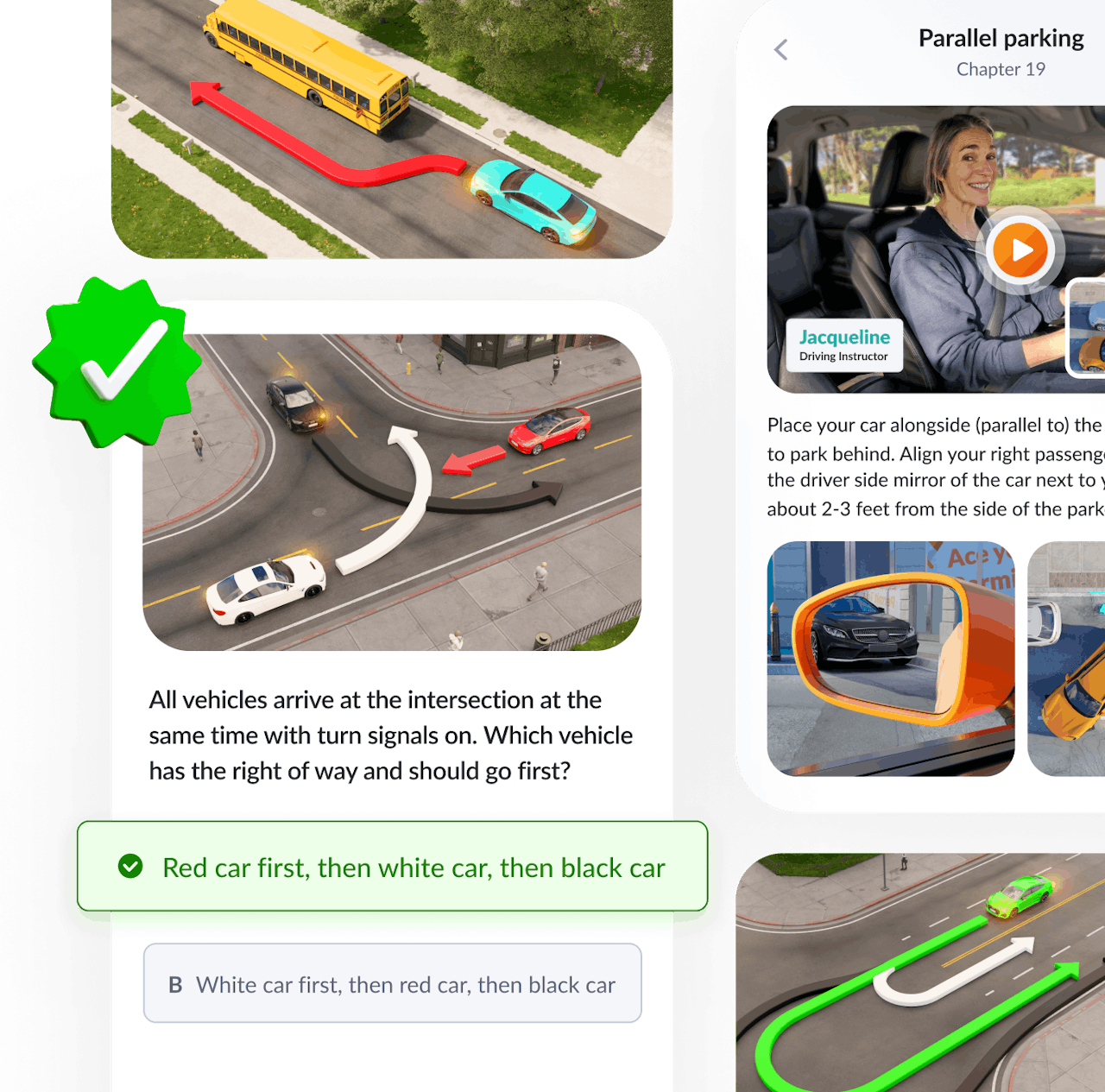
Take our full course with tests and theory
600+ exam-like questions and practice tests
Easy summarized DMV handbook
America’s #1 driver’s ed app with a 95.8% pass rate
Recommended articles

Ace your DMV test, guaranteed
Want to Be the Top School in Your Area?

- Simple & automated admin
- More time for teaching
- #1 learning materials for students
Start learning now
Resources
- Driver’s License Renewal
- How to Get Your US Driver’s License
- How to Prepare for Your Road Test
- How to Get a Driver’s Permit
- Behind-The-Wheel training
- Courses
- Blog
- FAQ
Show More


©2026 Zutobi AB, 4 Peddlers Row, Unit #103, Newark, DE 19702