Angled parking
Drive past the space until the near-side mirror lines up with the first line, then turn in. Your teen should center the car between the lines before stopping.
A parent's guide to parking lot skills, parallel parking, hill parking, and low-speed maneuvers your teen needs before the driving test.
Quick answer
How do I teach my teen to park?
Start in an empty parking lot at idle speed and build from simple pull-through spots to reverse-in parking, parallel parking, and hill parking. Each maneuver introduces one new steering input at a time so your teen builds muscle memory before adding complexity.
The Zutobi Parent Driving System covers every parking and low-speed maneuver in video-led lessons. Certified driving instructor Jacqueline walks you through each skill with coaching points you can repeat in the car.
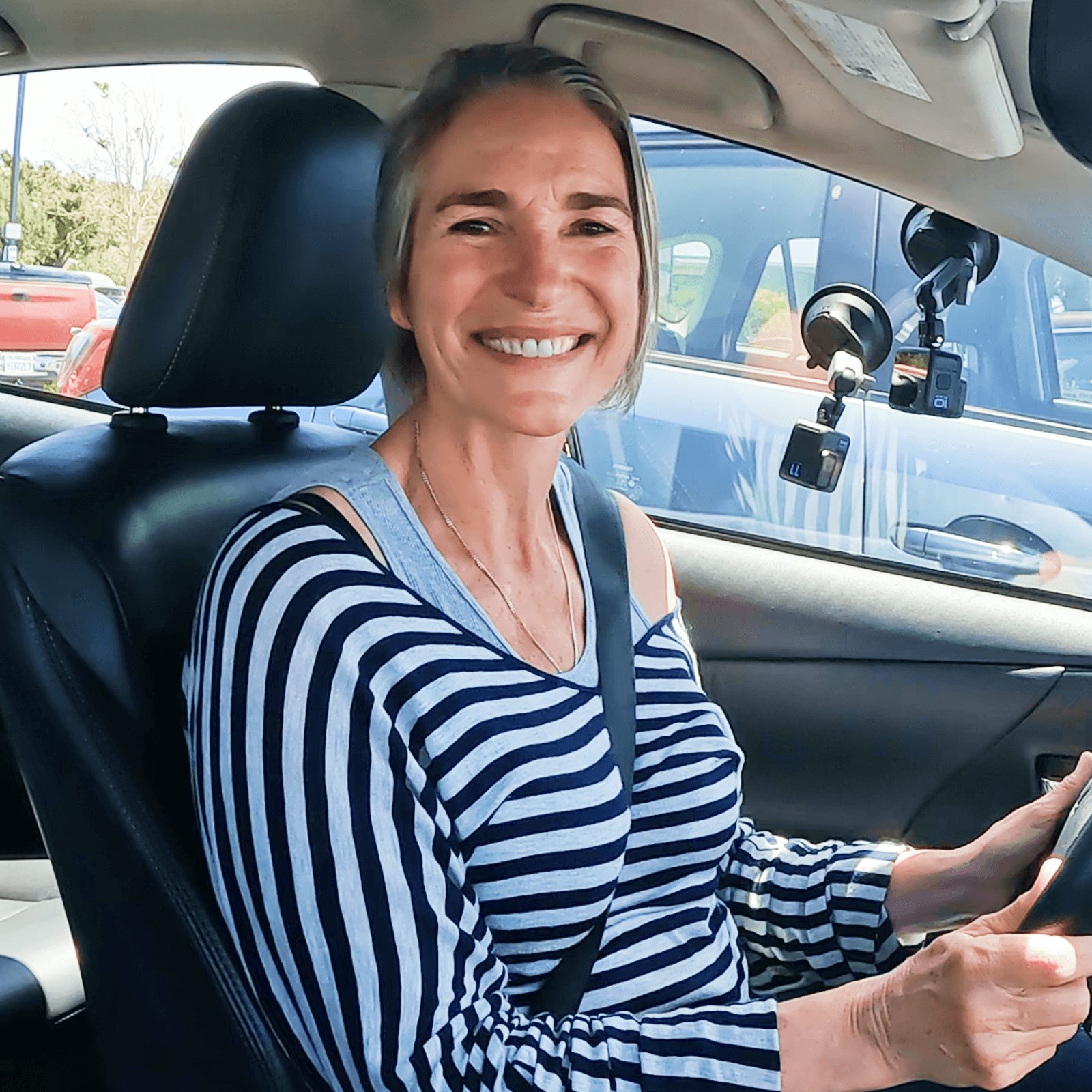
Before teaching specific parking maneuvers, your teen needs to handle the lot itself. Drive to a parking lot without heavy foot traffic and practice at low speed.
Enter at about 10 mph on the main aisle and slow to 5 mph inside parking lanes.
Watch for cars backing out of spaces and point them out before your teen reaches them.
Yield to pedestrians at crosswalks and near store entrances.
Signal early when turning into a lane or leaving a spot.
Practice driving to the exit, checking for oncoming traffic, and merging back onto the road.
Start with angled spaces. They require the least steering input and give your teen a quick win.
Drive past the space until the near-side mirror lines up with the first line, then turn in. Your teen should center the car between the lines before stopping.
This requires a sharper turn. Have your teen approach slowly, turn the wheel when the near-side mirror passes the line, and straighten once the car is halfway in.
Practice exiting: check mirrors, signal, and reverse out at idle speed. Stress the importance of scanning for pedestrians behind the car.
Once head-in feels routine, flip the approach. Your teen pulls slightly past the space, checks mirrors, then backs in using over-the-shoulder vision.
Reverse-in parking gives a clear sightline when leaving, which reduces the risk of backing into pedestrians. It is the preferred method in many driving programs.
Teach your teen to stay within the lines and leave room for doors on both sides.
Start with two cones placed about 15 feet apart in a quiet area, with no curbs or other cars. Once your teen can park consistently between cones, move to real spots on low-traffic streets.
Look for a gap at least 1.5 times the car's length. Beginners need that margin, and experienced drivers shrink it later.
Pull alongside the car in front until your passenger-side mirror aligns with their driver-side mirror. Keep about 2 to 3 feet of space between the two vehicles.
Turn the steering wheel one full rotation to the right and reverse slowly. Stop when both headlights of the car behind you appear in your left mirror.
The entire front of the rear car should be visible in the mirror. If it is not, straighten the wheels and continue reversing until it is.
Your right mirror should frame the tail light of the front car. Confirm the curb has just disappeared under the front-right door handle. This means you have room to complete the final turn.
Turn the wheel all the way to the left and reverse slowly until the car is in the space. Straighten the wheels and creep forward to center yourself between both cars.
Exiting a tight spot
Practice pulling out by alternating between reverse and drive at idle speed. Check all mirrors and blind spots at each direction change.
Small corrections beat starting over
If the car is still angled, pull forward slightly, readjust, and try again. Small corrections beat starting over.
Most state driving tests include a hill parking maneuver. The rule is simple: position the wheels so the car rolls away from traffic if the brakes fail.
Turn the wheels away from the curb (to the left). If the car rolls backward, the front tires catch the curb.
Turn the wheels toward the curb (to the right). A backward roll pushes the tires into the curb.
Turn the wheels to the right. The car rolls off the road instead of into the traffic lane.
Both maneuvers reverse your direction. Road width and traffic determine which one to use.
U-turns work on wide, open roads with clear visibility and light traffic. Check local laws before practicing, because many intersections and school zones prohibit them.
3-point turns fit narrow streets where a U-turn is not possible. The sequence: signal and check traffic, drive forward toward the far curb, reverse toward the near curb while steering the opposite direction, then drive forward in the new direction.
Backing while turning is the foundation of parking maneuvers. The PTTG covers this skill before introducing any parking technique.
The golden rules of reversing
Look behind you.
Physically turn your head and shoulders toward the direction of travel. Backup cameras supplement mirrors; they do not replace direct vision.
Steer toward the turn.
If the back of the car should go right, turn the wheel right.
Idle speed only.
Lift the toe off the brake and let the car creep. No accelerator.
Steering techniques for tight spaces
The PTTG introduces two methods with the car in Park before it moves. Hand-over-hand gives sharp, precise control for 90-degree backing turns, while palming the wheel works for slower, smoother corrections at very low speed.
90-degree backing turns
Drive forward into a parking lane, then reverse out with a 90-degree turn. Instructor Jacqueline teaches the "trace the curb" technique: look over the shoulder on the turning side and follow the curb or parking line as a visual guide around the corner.
Quarter-turn corrections
In reverse, small steering inputs create large direction changes. If the car drifts too close to or too far from the curb, a quarter-turn of the wheel corrects it. Stop, assess ("Are we parallel? Did we clear the obstacle?"), and pull forward to retry if needed.
Front-end swing
When the back of the car turns left, the front swings right. Before committing to any backing turn, check that the front end is clear of obstacles, bikes, and other vehicles.
Your teen should practice both with the engine running and the car stationary until the motion feels natural.
The PTTG covers parking and maneuvering across multiple video-led lessons, from first parking lot drives through parallel parking and hill techniques.
Video walkthroughs of every parking type and low-speed maneuver, led by instructor Jacqueline.
Coaching language for each step so you say the right thing at the right time.
A progression from open-lot basics to tight-space skills like parallel parking and 90-degree backing.
Skill-based tracking that shows which maneuvers your teen has covered and where gaps remain.
Start the system
Give your teen the safety advantage. Start the Zutobi Parent Driving System.


