loved by
15.1+ million
users
Why Nearly Half of American Drivers Don’t Think They’d Pass Their Driving Test Today

For most Americans, the driver’s license is a one-time exam. They pass it once at 16 or 17, the card lives in their wallet for the rest of their life, and nobody asks them to prove it again. Zutobi wanted to know what that permanence looks like in 2026. How confident do American drivers feel about the credentials they already hold?
To find out, Zutobi surveyed 1,000 U.S. adults aged 18 to 54 and asked one direct question: if you had to retake your driving test tomorrow with no preparation, how confident are you that you’d pass? Only 55.8% of licensed American drivers said they were sure they could. Nearly 1 in 8 said they would probably or definitely fail.
How many Americans think they’d pass their driving test today?
The American driver’s license is treated as something you earn once and own forever. Ask Americans whether they could actually pass that test today, and the answer is far less certain.
The survey asked: if you had to retake your driving test tomorrow with no preparation, how confident are you that you’d pass?
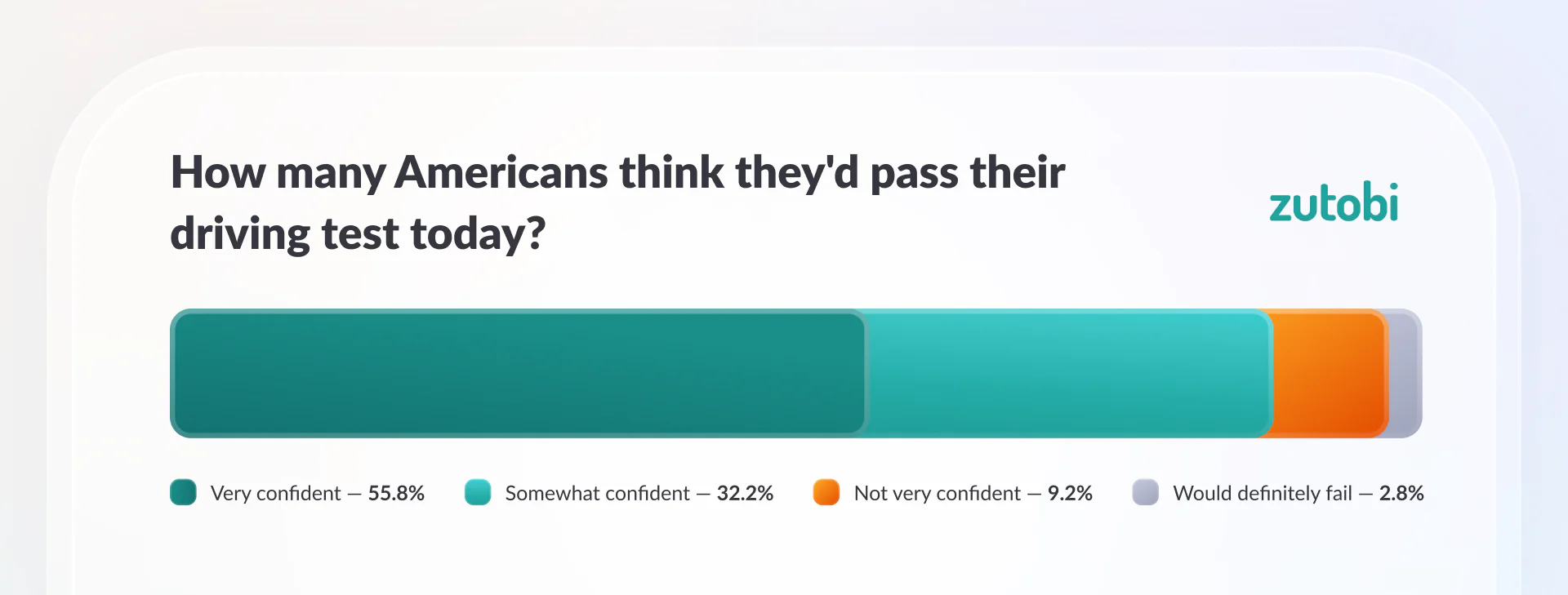
Only just over half of American drivers feel certain of the credentials they already hold. 44.2% are hedging. 12% are admitting outright that they would not pass.
Are women less confident drivers than men?
The sharpest divide in the data is gender.
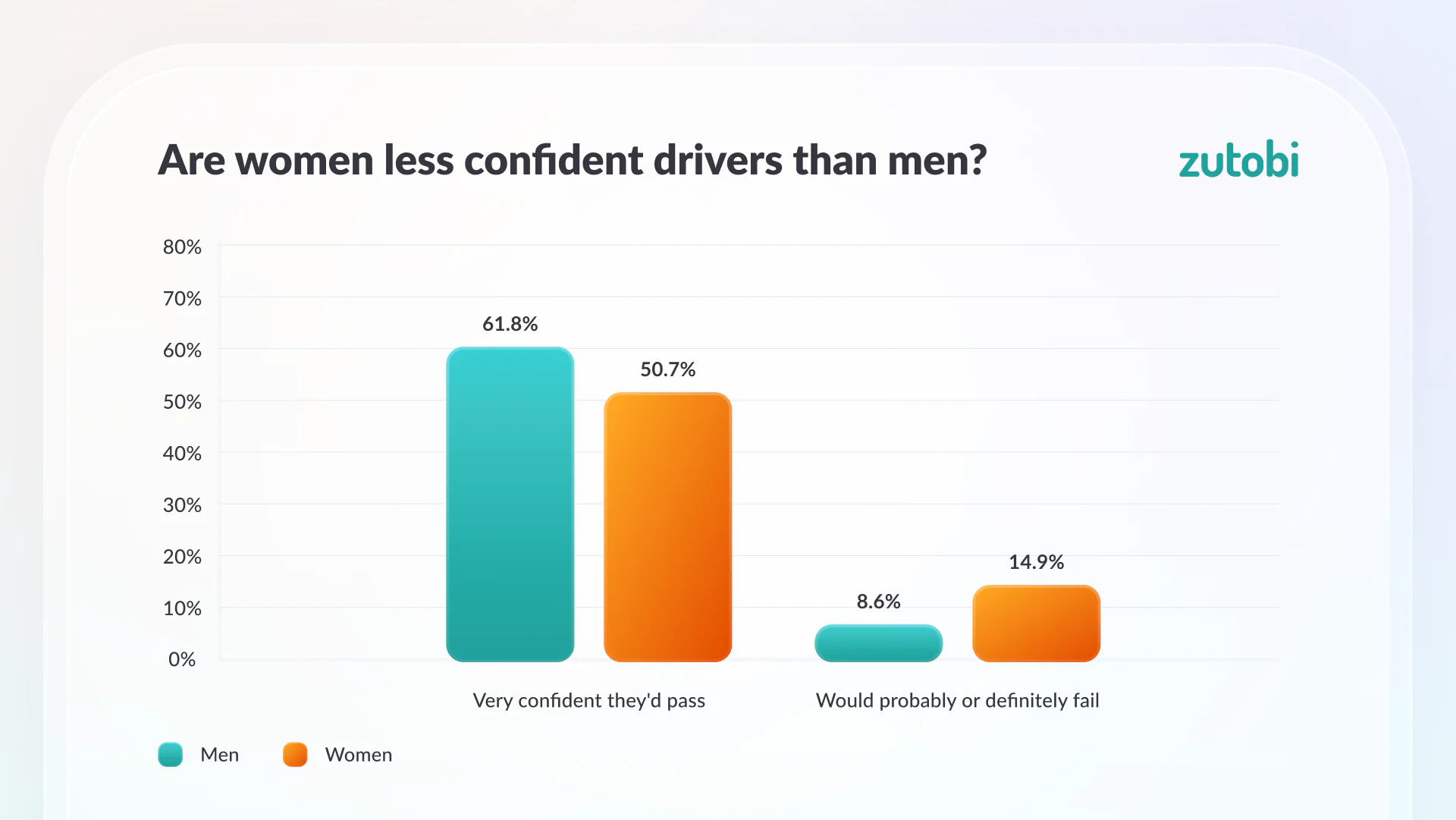
Women are 1.74 times more likely than men to expect they would fail their driving test today. That is an 11-point spread on confidence and almost a doubling on predicted failure between two groups holding the same license.
Layer age on top, and the picture sharpens. Among women aged 18-24, only 43.8% feel very confident they could pass. Among men the same age, 51.2% do. Young women carry the heaviest doubt in the country.
But less confidence does not mean less skill. Zutobi’s own road safety reports tell a different story. The Distracted Driving Report shows men accounted for 74.45% of all fatal distracted driving crashes in the U.S. in 2024. Men are also over 300% more likely to be involved in a fatal drunk driving accident than women, according to the US DUI Report.
The Zutobi survey points to the same conclusion the crash data already supports: this is a confidence gap, not a competence gap.
Which age group is least confident behind the wheel?
Confidence builds slowly, over years of driving, and the Americans who took the test most recently are the least sure they could pass it again.
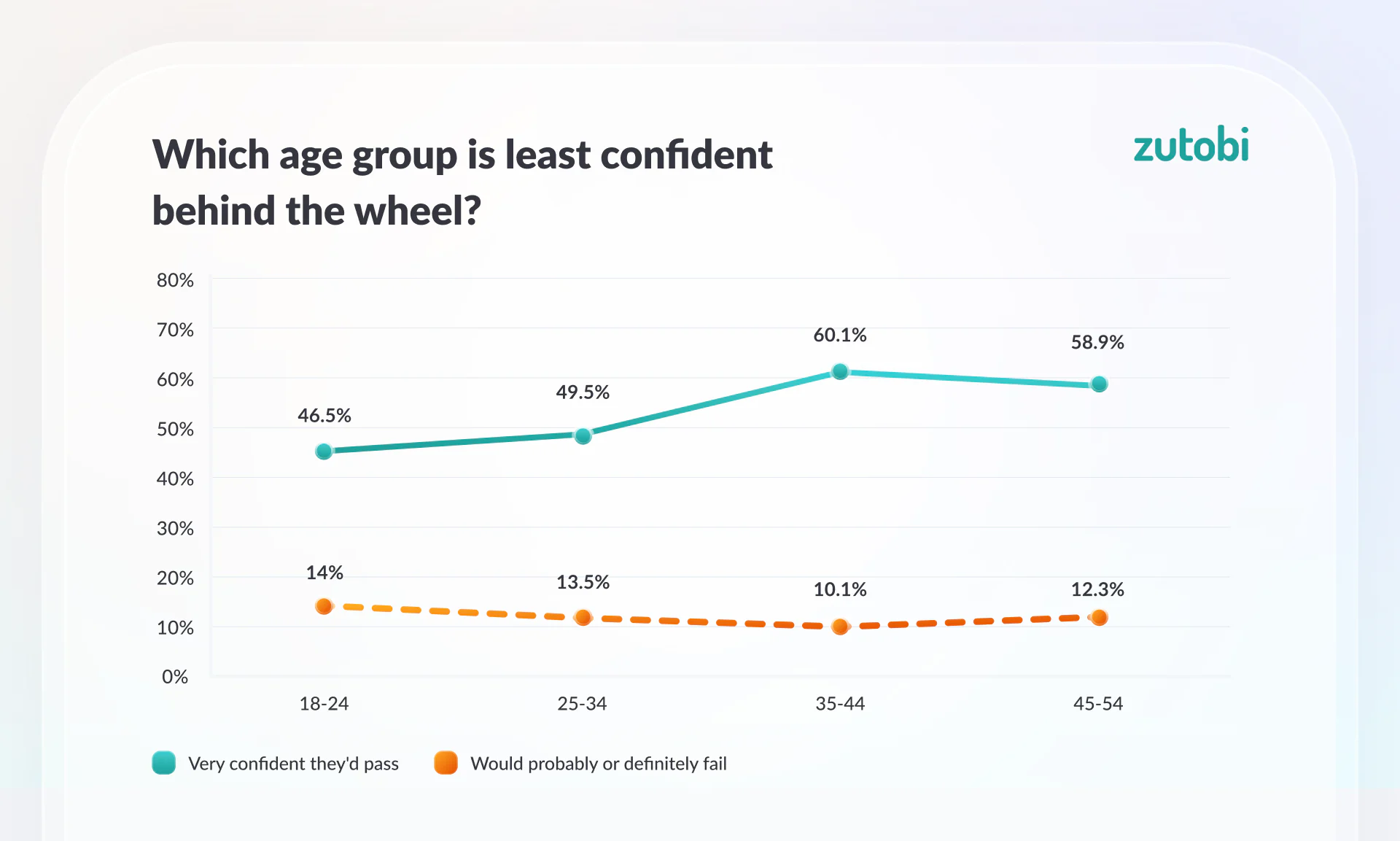
The most assured drivers in America are not 50-year-olds. They are the 35 to 44 cohort. By that age, the test is a distant memory, and a decade of road time has done the work the test never could. The youngest drivers, whose test memories are still fresh, doubt themselves the most.
How the person who taught Americans to drive predicts their confidence decades later
The single strongest predictor of how confident an American adult feels about driving today is not age, gender, income, or education. It is whether the person who taught them was patient.
| How learning to drive felt | Very confident today | Would fail today |
| Parent or guardian was calm and patient | 66.7% | 3.5% |
| Parent or guardian struggled to teach | 42.8% | 17.7% |
A 24-point gap in confidence with a 5x gap in predicted failure. Two groups of Americans who took the same test, separated by the temper of the person sitting in the passenger seat a decade or two ago.
“Americans whose parents were calm teachers are 5 times less likely to fear failing their driving test today than those whose parents struggled. The tone of the lessons stays in the driver’s seat for decades,” says Luke Waldenback, co-founder of Zutobi.
How Zutobi helps American drivers pass their test and keep their confidence
The survey shows two needs. First, drivers need to pass the test without fear. Second, drivers need to actually remember the rules years later. Half of the respondents are not sure they could pass the test they already passed. Passing the test is the first job, and keeping the knowledge is the second. Zutobi is built to do both.
Most drivers forget the rules because they used the state DMV handbook, which is not optimized for efficient learning. Zutobi rebuilds the same material into short, gamified lessons that follow how the brain actually stores information long-term. Learners understand the rules well enough to still know them ten years from now.
Zutobi is also the only U.S. driver’s ed app with a video handbook. Every topic, from road signs to right-of-way to parking, is taught through a short narrated video with real road demonstrations. Drivers see the rule in action and hear the explanation at the same time, which research consistently shows produces deeper understanding and stronger long-term memory.
For parents teaching their teens, Zutobi built the Parent-Teen Training Guide, a direct answer to the survey’s strongest finding: adults whose parent was a patient teacher are 5 times less likely to fear failing their test today. Created with certified driving instructors, the guide tells parents exactly what to teach and in what order. Each step lists the specific skills to cover and the common mistakes to avoid. So, parents help their teens build confidence that lasts decades.
FAQ
What percentage of Americans think they could pass their driving test today?
Only 55.8% of U.S. licensed drivers aged 18-54 say they are “very confident” they could pass their driving test tomorrow with no preparation. The remaining 44.2% are less sure: 32.2% are only “somewhat confident,” 9.2% are “not very confident,” and 2.8% say they would “definitely fail.”
Are women less confident drivers than men?
According to the Zutobi survey, women are 1.74x more likely than men to say they would fail their driving test today. 14.9% of women say they would probably or definitely fail, compared to 8.6% of men. Only 50.7% of women feel “very confident” they would pass, versus 61.8% of men. The survey frames this as a confidence gap rooted in social factors like teaching style and test-day judgment, not a difference in driving skill.
Does the person who taught you to drive affect your confidence as an adult?
Yes, significantly. Among American adults who say their parent or guardian was a patient and calm teacher, 66.7% are “very confident” they could pass their driving test today, and only 3.5% expect to fail. Among adults who say their parents struggled to teach them, only 42.8% are “very confident,” and 17.7% expect to fail. That is a roughly 5x gap in self-predicted failure between the two groups. In the Zutobi dataset, the patience of the person who taught you to drive is a stronger predictor of adult driving confidence than gender, age, income, or education.
What is Zutobi, and how does it help drivers prepare for their test?
Zutobi is the leading mobile driver’s education app, used by millions of learner drivers in the U.S. and beyond. It turns the official state driver’s manual into bite-sized, gamified lessons, making driver’s ed feel less intimidating and more approachable. Zutobi is built for the drivers this survey describes: people who want a patient teacher and durable knowledge years after they pass.
Methodology
All figures are from a Zutobi-commissioned survey conducted via Pollfish in May 2026 among 1,000 U.S. adults aged 18 to 54. The driving-confidence question is a single-selection question. Cross-tab figures by fear-type and learning experience are derived from multiple-selection questions, so totals within those questions can exceed 100%.
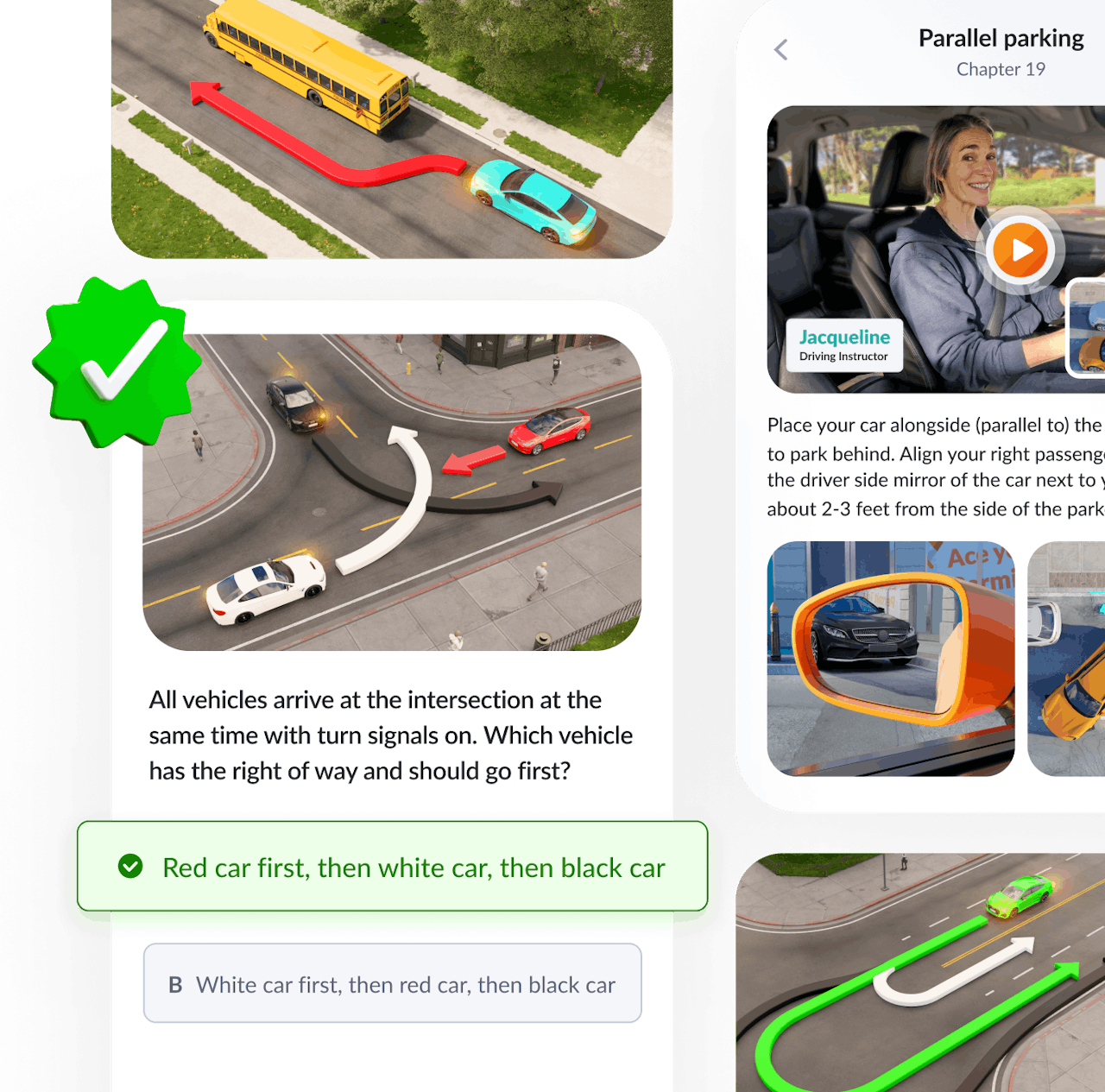
Take our full course with tests and theory
600+ exam-like questions and practice tests
Easy summarized DMV handbook
America’s #1 driver’s ed app with a 95.8% pass rate
Recommended articles

Ace your DMV test, guaranteed
Want to Be the Top School in Your Area?

- Simple & automated admin
- More time for teaching
- #1 learning materials for students
Start learning now
Resources
- Driver’s License Renewal
- How to Get Your US Driver’s License
- How to Prepare for Your Road Test
- How to Get a Driver’s Permit
- Behind-The-Wheel training
- Courses
- Blog
- FAQ
Show More


©2026 Zutobi AB, 4 Peddlers Row, Unit #103, Newark, DE 19702